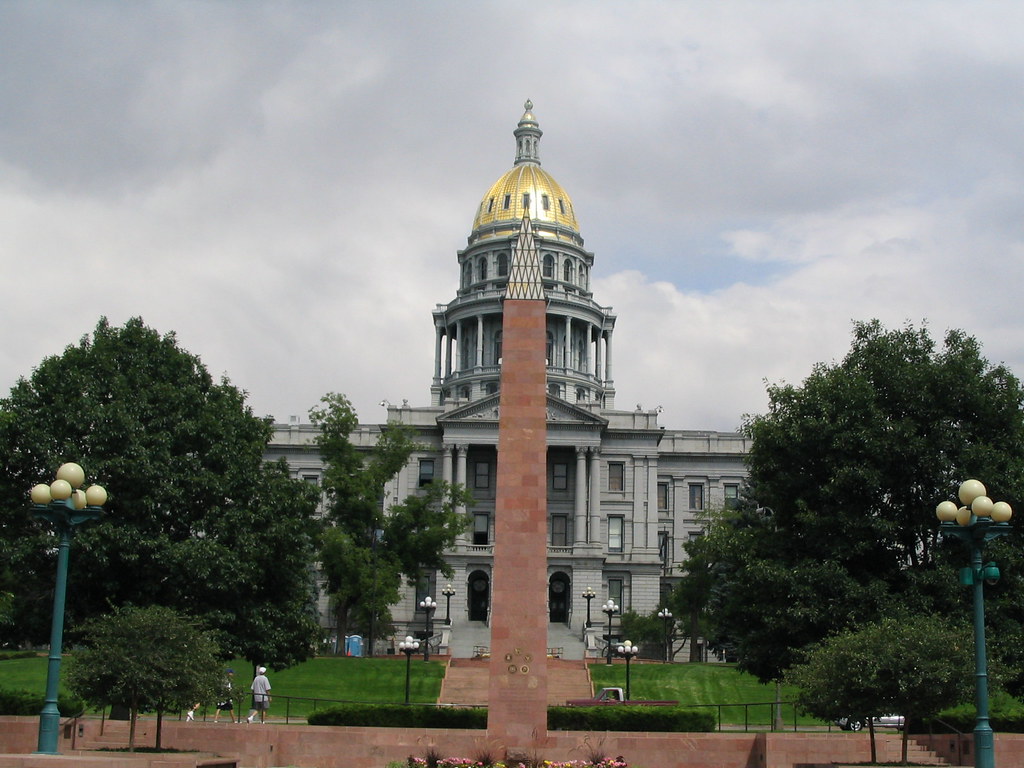
There is a moment, somewhere around the 180th step inside the inner dome of the Colorado State Capitol, when the city of Denver unfolds below you in a way that no rooftop bar or observation deck can quite replicate. The gold-leafed dome catches the afternoon light, the Rockies stretch in an improbable panorama to the west, and you realize you are standing inside a building that has been quietly extraordinary for well over a century — and that almost nobody outside of school field trips seems to know it this well.
The Colorado State Capitol sits at the eastern edge of Civic Center Park in the heart of downtown Denver, and on its own merits it is one of the most beautiful and accessible public buildings in the American West. Construction began in 1886 and stretched nearly two decades, with Colorado artisans and craftsmen sourcing virtually every material from within state lines — the rose onyx wainscoting lining the interior halls, for instance, came entirely from a single quarry near Beulah, Colorado, and that particular variety of marble has since been entirely exhausted. What you see on those walls is literally irreplaceable. That detail alone tends to stop people mid-stride.
The dome itself is sheathed in real gold leaf — 200 ounces of Colorado gold, to be precise — re-gilded most recently in 2013 to mark the state’s sesquicentennial. From the outside, it glows warm and almost amber in the late afternoon sun. From the inside, the journey to the top involves a narrow spiral staircase that opens onto an observation gallery at 272 feet above sea level, which, combined with Denver’s already elevated position, puts you at a genuinely dizzying vantage point. The views are sweeping and completely free.
Free is the operative word here. Tours of the Capitol are offered at no charge, Monday through Friday, led by knowledgeable and enthusiastic volunteer guides. The tours typically last about 45 minutes and cover the ornate legislative chambers, the stained glass portraits of Colorado pioneers that line the rotunda, and the story of how this building came together piece by painstaking piece. The guides have a gift for making the history feel alive rather than textbook-dry, and they field questions with genuine warmth.
Even on days when a tour doesn’t fit your schedule, you can walk in on your own and simply wander. The ground floor is open to the public during legislative sessions, and the architecture alone justifies the trip. Look up at the rotunda ceiling. Run your hand carefully along the onyx wainscoting. Pause in front of the stained glass and read the names etched into it — explorers, settlers, and visionaries who shaped this corner of the continent.
Outside, the Capitol steps have their own small piece of geography: a brass marker on the 13th step is officially designated as exactly one mile above sea level, making it perhaps the most photographed single stair in the state. It is a minor thing, but people genuinely love it, and the steps themselves offer a fine perch for watching the rhythm of downtown Denver moving past Civic Center Park below.
If you are planning a visit, weekday mornings are the quietest. Parking is available at nearby meters and garages along 14th and 16th Avenues, and the Capitol is a short walk from several RTD light rail and bus stops. Bring a light jacket if you plan to go all the way up to the observation gallery — it can be breezy up there regardless of the season, and the effort is absolutely worth the extra layer.
Denver has no shortage of things to do and places to eat and experiences to seek out. But there is something grounding and genuinely moving about standing inside a building this old, this carefully made, this openly shared with the public at no cost at all. The Colorado State Capitol does not try to sell you anything. It just stands there, golden and patient, and lets the story speak for itself.