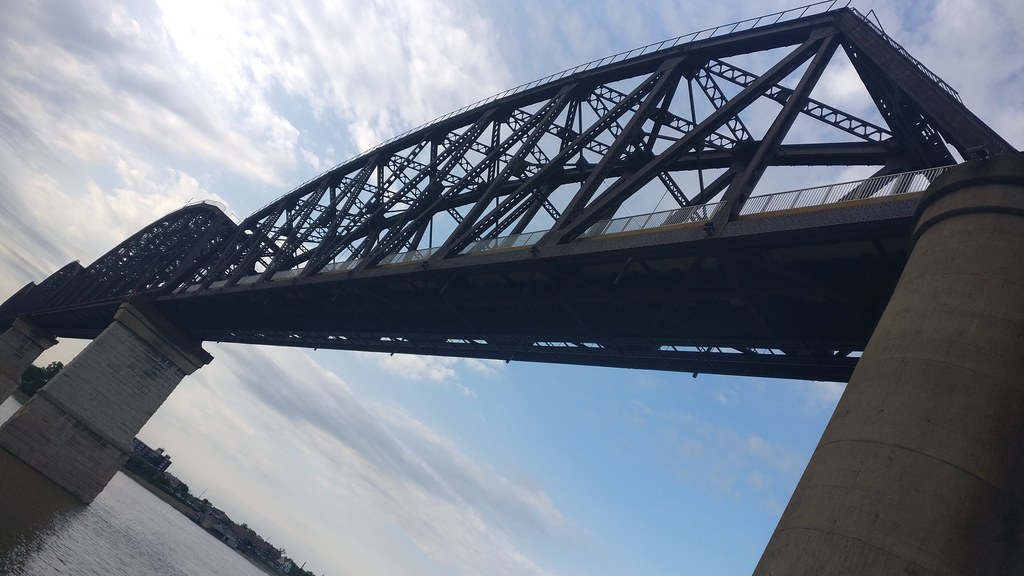
There is a moment, about halfway across the Big Four Bridge, when the Ohio River opens up on both sides of you and Louisville’s skyline frames itself perfectly to the west. The light catches the water, a barge inches along below, and you realize you are standing in the middle of a river on a repurposed railroad bridge that has been transformed into one of the most quietly spectacular pedestrian experiences in the entire region. That moment alone is worth the trip.
The Big Four Bridge connects Louisville’s Waterfront neighborhood — specifically the area just east of downtown, near the foot of Washington Street in Jeffersonville, Indiana on the northern end — to Louisville’s own Waterfront Park on the Kentucky side. The bridge takes its name from the old Cleveland, Cincinnati, Chicago and St. Louis Railway, nicknamed the “Big Four” railroad, which used this crossing from 1895 until rail traffic eventually ceased. For decades it sat dormant, its deck gone, its iron towers watching the river in silence. Then Louisville and Jeffersonville had the good sense to bring it back to life as a pedestrian and cycling bridge, and it opened to the public in stages between 2013 and 2014. Today it is free to walk or ride across anytime, dawn to dusk.
Walking the bridge takes about fifteen to twenty minutes at an easy pace, and every step rewards you. The wide, well-maintained deck handles strollers, cyclists, joggers, and leisurely walkers without anyone feeling crowded. On weekends especially, it has the pleasant energy of a neighborhood gathering place suspended in mid-air over a working river. Dogs on leashes trot along happily. Couples linger at the railing. Kids press their faces through the ironwork to watch towboats pass far below.
What makes the Big Four Bridge feel special rather than merely functional is its scale and its history. The original iron towers still stand, massive and weathered, giving the crossing a genuine sense of industrial heritage. You are not walking across a new construction pretending to be old — you are walking across something that has genuinely earned its age, now put to a better, more human use than it ever served before.
On the Kentucky end, you step directly into Waterfront Park, where trails, green space, and river views extend in both directions. On the Indiana end, Jeffersonville’s charming riverfront district is just steps away, with restaurants and coffee shops ready to extend the afternoon. Many visitors make it a loop: cross the bridge, explore a little, cross back, and feel like they have actually traveled somewhere — which, technically, they have. Two states, one walk, no admission fee.
Go in the morning when the light is soft and the foot traffic is light. Go at golden hour when the sky over the Louisville skyline turns the color of a bourbon barrel. Go in any season — the bridge is striking under snow, vivid in summer green, and heartbreakingly beautiful when the trees along the banks turn in October. However you time it, the Big Four Bridge delivers the kind of uncomplicated, genuine pleasure that reminds you why travel writing exists in the first place: to send people toward things that make them glad they left the house.