In a heartfelt effort to keep the memory of Cleveland’s native hero Jesse Owens alive, the Cleveland Black Equity and Humanity Fund has taken stewardship of four cloned oak saplings that descend from the English oaks gifted to Owens after his historic four‑gold‑medal performance at the 1936 Berlin Olympics.
Local roots, national significance
Owens arrived in Cleveland at age nine when his family moved from Alabama. He attended Bolton Elementary in the Fairfax neighborhood and later East Tech High School, where his track talent quickly made him a citywide sensation. After a successful collegiate career at Ohio State—balancing rigorous training with work to support his parents and a newborn child—Owens qualified for the Berlin Games. Despite the Nazi regime’s racist propaganda, he captured gold in the long jump, the 100‑ and 200‑meter dashes, and the 4 × 100‑meter relay, turning his victories into a powerful rebuke of racial hierarchy.
Each gold medal originally came with an English oak sapling. Owens returned to Cleveland with four of these trees. Three were lost to time, but one was planted outside James Ford Rhodes High School in Old Brooklyn in the late 1930s. That tree died in spring 2022, prompting a preservation project.
Cloning the historic oaks
Arborist Jeffrey Verespej, former leader of the Old Brooklyn Community Development Corp., collaborated with Holden Forests & Gardens—operators of the Cleveland Botanical Gardens and Holden Arboretum—to propagate new saplings from the remaining branches of Owens’ original tree. The propagation process involved grafting trimmed branches onto root systems, resulting in nearly two dozen healthy clones.
Four of those clones have now been planted across Cleveland, and the fund plans to auction the remaining saplings, selling roughly one each month. Proceeds will flow back to the fund, Holden Forests & Gardens, and the Jesse Owens Foundation, supporting a year‑long educational initiative.
Community involvement and education
“How do we make sure that today’s young people understand Jesse Owens—who he was, what he did, the times in which he lived, and the courage he showed?” asked Kevin Johnson, co‑founder of the fund. “We didn’t just take on a sapling. We took on all of this.”
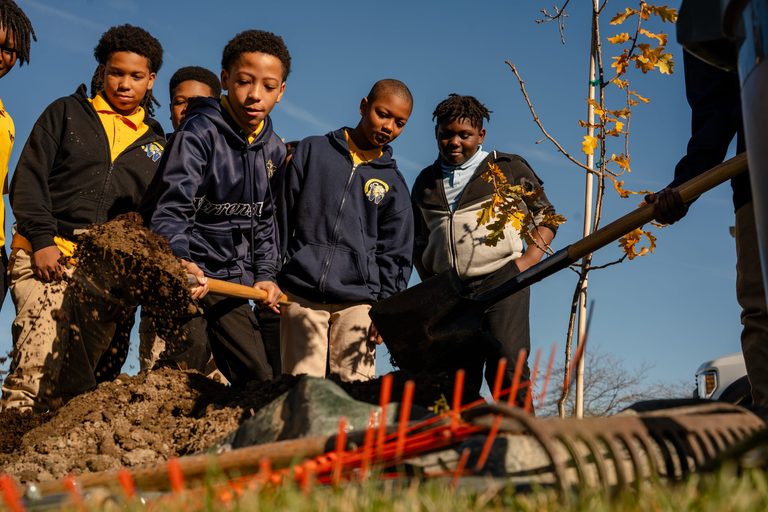
Local philanthropist Madeleine Parker purchased the first sapling at auction and planted it in her yard, later arranging for a second to be placed at the Cleveland Metroparks Patrick S. Parker Community Sailing Center on the East 55th Street marina. Students from Warrensville Heights Middle School also helped plant a sapling, reinforcing the educational thrust of the project.
In partnership with the Ohio High School Athletic Association, the fund successfully renamed the state’s annual track and field championship in Owens’ honor, ensuring his athletic achievements remain a visible part of Ohio’s sports heritage.
Looking forward
Johnson emphasizes that Owens’ story is more than a sports triumph; it is a testament to perseverance in a pre‑Civil Rights era when no template existed for African‑American athletes. “He was there by himself trying to figure this out,” Johnson said. “In many ways, he reminds me of my family, who thought that if they did certain things, things would really change. And yet here we are in 2026, still fighting for our history.”
The cloned oaks now stand as living monuments, inviting Cleveland residents to reflect on Owens’ character, his contributions to the community, and the ongoing fight to preserve African‑American history. As the saplings grow, they carry forward a legacy that bridges past courage with present‑day hope.
Original reporting: Signal Cleveland — read the source article.