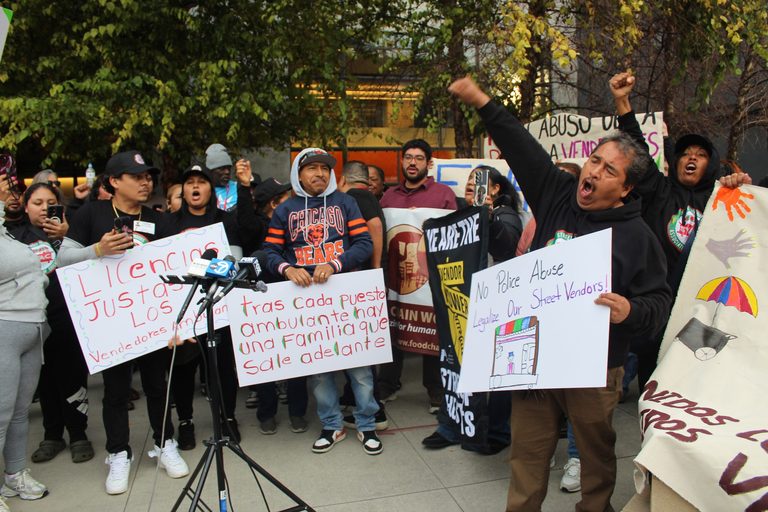
On Monday, street vendors and food workers gathered in downtown Chicago, assembling in front of the historic Haymarket Memorial to demand greater protections and flexibility under a proposed city ordinance. Demonstrators, chanting in Spanish, proclaimed, “No somos delincuentes, somos vendedores,” emphasizing that working on the streets is a legitimate livelihood.
Vendor leaders outline current challenges
The Street Vendors Association of Chicago, together with the Food Chain Workers Alliance and other advocacy groups, has spent years lobbying for reforms. Although the association helped legalize street vending in 2015, vendors still face strict limits that prevent them from preparing fresh-to-order meals. Under existing rules, vendors may only sell pre‑packaged items, must move their carts every four hours, and are required to use a licensed commercial kitchen and obtain a tax number before they can sell.
Juan Gama, president of the Street Vendors Association, told Block Club that the new ordinance would allow vendors to sell hot and cold foods, including traditional items such as corn and champurrado, a Mexican drink. He explained that the proposal would introduce a two‑year license costing $500, a step toward formalizing the industry and expanding entrepreneurial opportunities.
Mayor’s proposal and vendor feedback
Mayor Brandon Johnson introduced the ordinance as part of his 2027 budget, aiming to address licensing gaps and create clearer pathways for vendors to operate legally on public streets. In a statement, Johnson said the plan would “open new opportunities for food entrepreneurs while addressing gaps in the City’s licensing framework.” He also noted ongoing conversations with Chicago Police Department leadership to enforce existing regulations without causing unnecessary harm to residents.
While the mayor’s proposal marks progress, vendors say further adjustments are needed. Gama indicated the association is negotiating to extend the mandatory four‑hour cart relocation requirement to six hours, reduce fines, and lower the license fee from $500 to $200. He added that the group plans to meet this week with alderpeople and the Department of Business Affairs and Consumer Protection to discuss these changes.
Council members raise concerns
Pooja Ravindran, chief of staff for the City Council’s Committee on Immigrant and Refugee Rights, expressed reservations that the draft ordinance does not go far enough. She highlighted a 200‑foot restriction that would still prevent vendors from selling near brick‑and‑mortar businesses, and warned that new sanitation specifications could increase costs for small operators. Ravindran also pointed out that many alderpeople have historically restricted peddlers in their wards, a practice the ordinance does not directly address.
Ravindran further noted that the proposal does not resolve what she described as “discriminatory ticketing and mass arresting practices” that have plagued vendors, especially those who are undocumented immigrants.
Community voices echo the call for fairness
Guadalupe Sosa, a New York‑based street vendor and organizer with the nonprofit Street Vendor Project, attended the rally and shared stories of vendors living in constant fear of federal immigration enforcement. “Being a worker is not a crime,” Sosa said, urging the Chicago City Council to sit down with vendors and reach a fair agreement. She also highlighted the hardship of elderly vendors forced to move heavy carts every four hours under current rules.
The rally underscored a broader desire for the city to recognize street vending as a legitimate, family‑supporting enterprise that contributes to Chicago’s vibrant neighborhoods. As the ordinance moves through the budget process, vendors hope the city will adopt their recommendations, ensuring that licensing is affordable, relocation requirements are reasonable, and enforcement is fair.
Next steps
The proposed ordinance must secure the support of at least 26 alderpeople to be included in the 2027 budget. Vendors and advocacy groups plan to continue lobbying city officials, emphasizing the economic and cultural benefits of a thriving street‑vendor sector. The outcome will shape how Chicago balances public‑space management with the entrepreneurial spirit of its diverse communities.
Original reporting: Block Club Chicago — read the source article.