Saturday mornings on César Chávez Avenue have their own rhythm. By eight o’clock the bread trucks are parked, the fruit carts are out, and Carnitas Michoacanas has already been cooking since before dawn. The smell finds you before the sign does — copper lard, orange peel, and something faintly sweet that turns out to be the piloncillo they add to the pot. You follow your nose and end up at a low counter with a sheet of butcher paper in front of you.
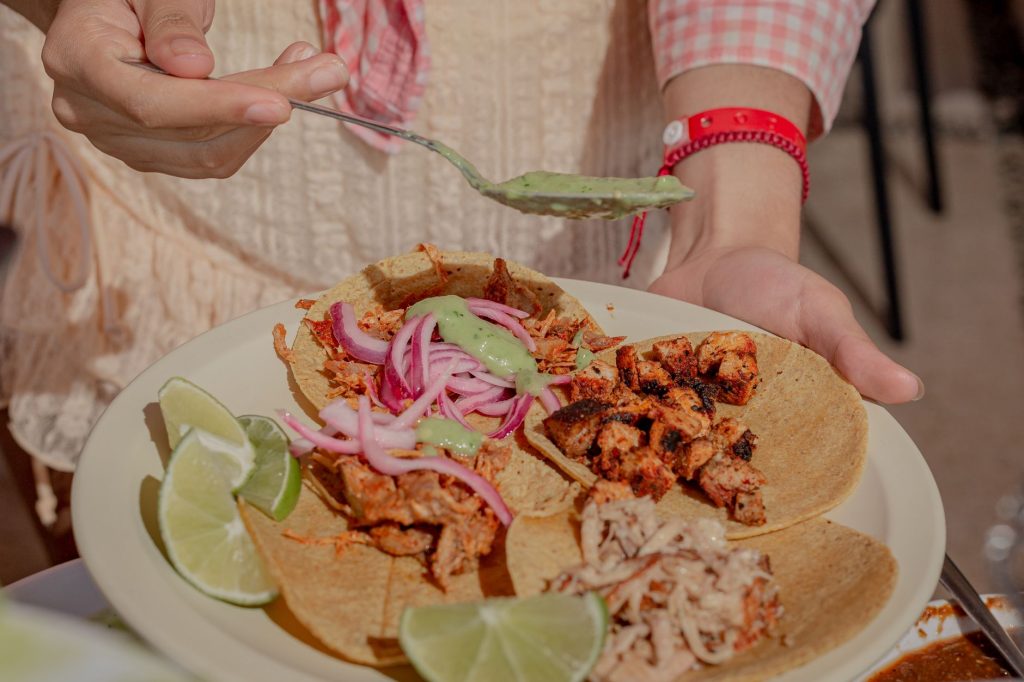
The operation is straightforward. You order by the pound — carnitas, maciza, cuerito, buche, or a mix — and they hand it to you wrapped or on a tray with warm tortillas, fresh salsa verde, raw onion, and cilantro. The maciza is the lean shoulder meat, properly browned on the outside, still moist inside. The cuerito — braised pig skin — has that soft-yielding texture that either gets you immediately or takes a few visits. First-timers usually start with a mixed pound of maciza and a little surtida, which pulls from whatever they’ve been holding warm in the copper.
Prices run around seven to nine dollars a pound depending on the cut, which is honest money for this quality. A pound between two people, plus tortillas, makes a full meal. If you’re feeding a crowd, they sell in larger quantities and have done it enough times that the math is fast and the wrapping is tight.
What makes this place worth coming back to is consistency. Carnitas done well requires patience and temperature control — too hot and the fat seizes, too low and the meat steams instead of braises. The people running this kitchen have clearly been doing this for a long time. The copper pot visible from the counter isn’t decorative. It’s the actual vessel, blackened from use, and the carnitas comes out of it tasting like it should: rich without being greasy, with a crust on the edges that holds up even after you’ve wrapped it in a tortilla and driven home.
Go on a Saturday morning if you can. The line moves, but it moves faster early. By ten the place is busy enough that you’ll wait a few minutes, which gives you time to watch how the counter works — orders called out, weights called back, the whole thing organized without drama. By early afternoon some cuts start to run short, especially the buche. Sunday mornings are similar, though slightly calmer.
Parking on César Chávez is whatever you find. Street spots turn over steadily. The neighborhood is entirely walkable from Soto, and if you’re coming from Boyle Heights you can make the walk in under fifteen minutes and arrive with an appetite.
There’s no seating inside, a few spots outside when weather allows. This is primarily a take-out and take-home operation, and the people who come here know that. They bring their own containers sometimes, or they eat standing at the counter with their elbows on the rail, which is a completely reasonable thing to do on a Saturday in East L.A. when the carnitas is this good.