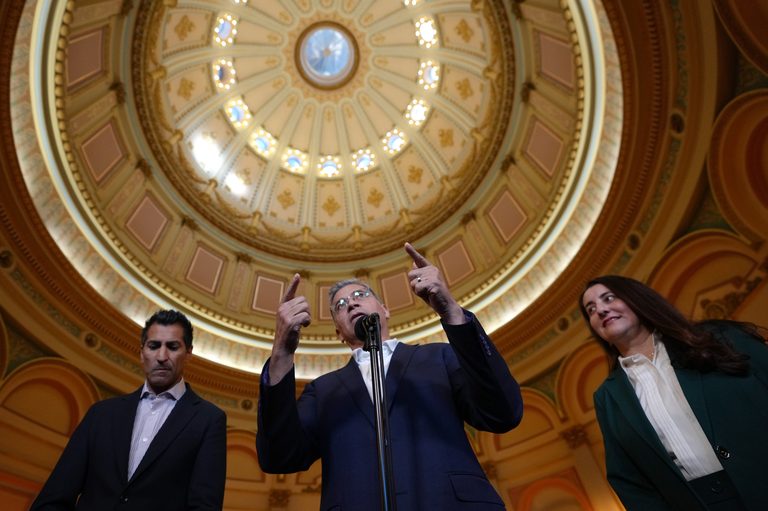
California voters have elected Democrat Xavier Becerra as the state’s next governor, continuing a remarkable streak of five consecutive Catholic governors. Becerra, a former U.S. health and human services secretary, cited his Catholic upbringing as a guiding influence, noting that “the sanctity of life is something that’s really ingrained in you.”
Faith and politics intersect in a diverse state
While Becerra’s Catholic background is clear, his support for abortion rights has surprised some observers. The complexity mirrors a broader national picture: American Catholics are politically mixed, with no single “Catholic vote.” David Gibson, director of Fordham University’s Center on Religion and Culture, emphasized that white evangelicals tend to back Republicans, while Black Protestants lean Democratic, making religious groups less predictable than often assumed.
The AP Voter Poll, which surveyed roughly 100,000 midterm voters, showed that about two in ten voters in the governor’s race identified as Catholic, and roughly six in ten of those Catholic voters supported Becerra. Among Latino Catholics, about seven in ten voted for Becerra, while white Catholic voters were more evenly split between Becerra and his Republican opponent, Steve Hilton.
Historical context of Catholic influence
California has the largest Catholic population of any U.S. state, with a 2024 Pew Research Center poll indicating that 25% of adults identify as Catholic—nearly half of the state’s Christians. Since Gray Davis took office in 1999, four of the five Catholic governors have been Democrats, including Jerry Brown, who was once a seminarian.
The Catholic tradition in California blends progressive social teaching with official church positions that oppose abortion and in‑vitro fertilization. This theological mix helps explain why Catholic voters do not always align neatly with one party.
Governor Newsom’s death‑penalty reforms
Governor Gavin Newsom, also a Catholic, recently announced a plan to convert more than 500 death sentences to life without parole. The California Catholic Conference praised the move, with Newsom stating, “I take this action because I firmly believe that state‑sanctioned killing is incompatible with California’s values, undermines the foundations of our legal system, and diminishes each of us.”
Some clergy have pushed back against Trump‑era policies, such as San Bernardino Bishop Alberto Rojas, who excused parishioners from weekly Mass after immigration detentions on church property. Others, like San Francisco Archbishop Salvatore Cordileone, have taken strong conservative stances, notably barring Rep. Nancy Pelosi from Communion in 2022 over her abortion‑rights advocacy.
Legacy of the missions and cultural impact
The state’s 21 historic missions, founded between 1769 and 1823, remain cultural landmarks despite a mixed legacy. Historians note that the mission system spread disease and caused a dramatic decline in Indigenous populations. Nonetheless, many missions continue as active parishes and influence California’s Spanish Colonial Revival architecture.
Local resident Tracy Creighton, who lives near Mission San Luis Rey in Oceanside, described the missions as woven into community life, saying, “Everyone does their homecoming pictures, their Christmas pictures. It’s just ingrained in us.”
Everyday Catholic life in California
Across the state, Catholic traditions persist in homes and daily routines. Fresno resident Brian Murillo, who describes himself as a lapsed Catholic, still offers a Hail Mary or Our Father before leaving the house, illustrating how faith remains a personal touchstone even for those less involved in church life.
Overall, Becerra’s victory underscores the enduring role of Catholicism in California’s political and cultural fabric, while also highlighting the nuanced ways faith interacts with modern policy debates.
Original reporting: NBC4 Los Angeles — read the source article.