President Nayib Bukelle of El Salvador announced Wednesday that his troops used helicopters and explosive drones to destroy the opulent mansion of a prominent Haitian gang leader known as Jeff. The attack was presented as a “gift to the Haitian people” on the anniversary of the historic Battle of Vertières, which secured Haiti’s independence.
Operation details
Bukelle shared a video on X that combined archival footage of Jeff posing in front of his mansion with new footage of Salvadoran aircraft approaching the property and firing, producing large plumes of smoke. The mansion, built in mid‑2024, featured a pool emblazoned with Jeff’s logo and was easily identifiable from satellite imagery.
According to Diego Da Rin, a Haiti specialist with the International Crisis Group, the home’s location made it vulnerable to aerial attack, though a ground assault would have been difficult. Da Rin described Jeff’s organization, sometimes called the Taliban gang, as one of the most organized criminal groups in the capital, controlling the Canaan district of northern Port‑au‑Prince.
Local reaction
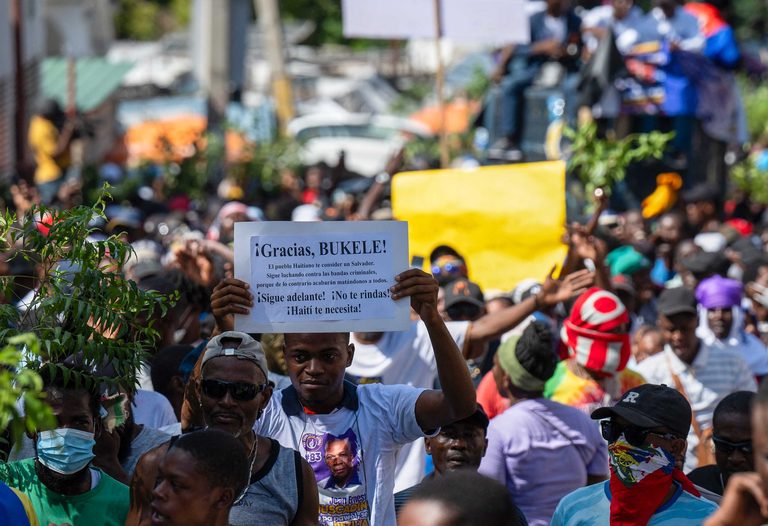
Hundreds of Haitians gathered in Port‑au‑Prince to celebrate the strike, thanking Bukelle for confronting the gangs that have terrorized their neighborhoods. “Jeff is a criminal and I hope he died,” said Mario Jean‑Pierre, a 45‑year‑old salesperson, adding that the community had asked for help and Bukelle answered.
The celebration follows a recent march in which thousands of Haitians expressed gratitude for Bukelle’s deployment of roughly 2,500 troops earlier this month after four Salvadoran soldiers were ambushed in gang‑held territory.
Critics voice concerns
While many praised the decisive action, analysts warned that the use of explosive drones and helicopters—capabilities Haitian police and military lack—could increase civilian casualties. Sandra Pellegrini, senior analyst at the Armed Conflict Location and Event Data Project, noted that gangs often retaliate against civilians to undermine support for foreign forces.
Both Pellegrini and Da Rin cautioned that retaining long‑term control over reclaimed neighborhoods will be a persistent challenge, emphasizing the need for a sustainable security strategy that protects innocent residents.
Broader context
The strike comes a day after a similar operation targeted the home of Wilson Joseph, known as Lanmò San Jou, leader of the 400 Mawozo gang. Although Joseph survived, the pattern suggests a coordinated effort to dismantle the fortified residences of Haiti’s most powerful warlords.
Jeff and Lanmò San Jou are allies who dominate the main roads north and east of Port‑au‑Prince, collecting tolls that fund their criminal enterprises. Their strongholds have long been described as “untouchable” by locals, a perception now challenged by Bukelle’s aerial campaign.
Looking ahead
Humanitarian groups and Haitian authorities continue to monitor the situation closely. While the immediate destruction of Jeff’s mansion signals a bold step against gang impunity, the ultimate success of Bukelle’s intervention will depend on how well security forces can maintain order and protect civilians in the reclaimed territories.
Original reporting: Oklahoma City News Feed (HLL/CB) — read the source article.