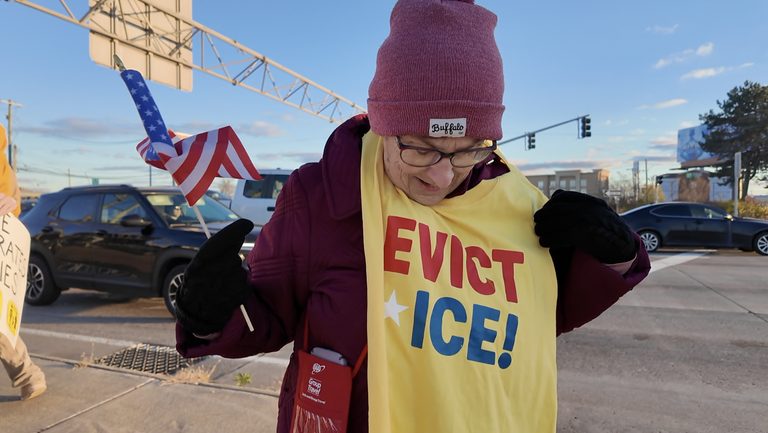
On Tuesday, as Thanksgiving approached, a coalition of local volunteers, faith‑based leaders, and concerned citizens assembled outside Buffalo Niagara International Airport to call for an end to flights carrying illegal immigrants under the custody of U.S. Immigration and Customs Enforcement (ICE). The demonstration, organized by the Buffalo Ends ICE Flights Coalition, was intended to highlight the treatment of individuals being transported through the airport and to demand greater transparency from federal authorities.
Community voices stress democratic values
Stephanie Mejia, executive director of the Western New York Peace Center, told reporters the protest reflects a deep‑rooted desire among Buffalonians to have their concerns heard. “What is America made of other than resisting and making sure democracy is available for all?” Mejia asked, invoking the nation’s founding principles. She added that the turnout demonstrated the strength of the community when neighbors unite to address issues affecting their neighborhoods.
Protester David O’Donnell echoed that sentiment, saying speaking out is part of preserving the democratic heritage passed down through generations. “People fought for this country for hundreds and hundreds of years, and it’s our duty to preserve our democracy,” he said.
Why the airport was chosen
Brandon Buchanan, another demonstrator, explained that the airport was deliberately selected because it serves as a hub for the contested ICE flights. “We wanted to bring it here since this is where the heart of these flights are being sent out of, and it’s just really unacceptable,” Buchanan said. “And we need to be in all the places that ICE is.”
Local officials clarify jurisdiction
The Niagara Frontier Transportation Authority (NFTA) quickly responded, stating that it does not facilitate, coordinate, oversee, or participate in ICE operations at Buffalo Niagara International Airport. In a written statement, NFTA Public Information Officer Kelly Khatib noted that federal law‑enforcement activities are managed solely by the respective federal agencies. The authority also emphasized that the airport cannot choose which planes take off or land, as federal law and grant agreements prohibit the airport from blocking or screening specific carriers.
“Federal law enforcement activities are managed by the respective federal agencies,” Khatib wrote, directing any questions about ICE policies to U.S. Immigration and Customs Enforcement.
Balancing local concerns with federal responsibility
While the protest underscores local frustration with federal immigration enforcement, the response from NFTA highlights the limits of municipal authority in matters that fall under federal jurisdiction. This distinction is important for residents who seek accountability: the airport and local transit agencies can advocate for transparency, but they do not have the power to halt or reroute ICE flights.
Community leaders expressed hope that the demonstration will draw sustained attention to their concerns and encourage continued civic involvement. “A lot of people have engaged, and it just shows how strong the community is,” Mejia said. “This is what America looks like when people unite and say, ‘Hey, we don’t like what we’re seeing in our community. We’re going to bring attention to it and we’re going to change it for the better.’”
Looking ahead
As the debate over ICE operations continues at the national level, local residents of Buffalo remain committed to voicing their perspectives and seeking greater oversight. The protest serves as a reminder that, even when federal policy is set in Washington, community members can organize, speak out, and demand that their elected representatives address the impact of those policies on everyday life.
Original reporting: WKBW 7 Buffalo (Buffalo section) — read the source article.