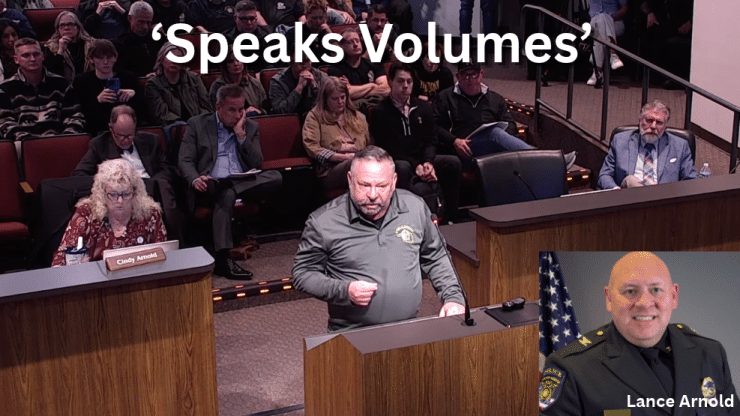
Broken Arrow – Residents returned to City Council on Tuesday to press city officials for more transparent leadership after Police Chief Lance Arnold was placed on paid administrative leave last month. The leave, described by the city as a response to “operational issues,” has sparked a public debate about how the situation was communicated.
Community concerns raised
Long‑time resident Brian Cathey, who also spoke in support of Chief Arnold at a prior meeting, expressed his frustration with the city manager’s handling of the announcement. “My frustration is directed at how the city manager has handled the communication, and with leadership surrounding this situation,” Cathey said. “We, as a community, are not asking anyone to compromise an investigation. We’re asking for leadership from each of you.”
Cathey added that citizens cannot be expected to trust a process that appears to ignore their concerns, emphasizing that leadership is about serving the people, not merely managing policies or procedures.
Retired officer backs chief
Retired Broken Arrow Police Officer Chris Walker, a member of Fraternal Order of Police Lodge 170, echoed the sentiment that the situation was mishandled from a public‑relations standpoint. “In 27 years, I have never seen an FOP lodge stand hand in hand with a police chief in opposition to city administration. That speaks volumes,” Walker said. He noted that officers and community members have publicly demonstrated confidence in Chief Arnold, while also stressing that accountability and fairness must be mutual.
Details of the internal dispute
Emails obtained by the media and cited by Arnold’s attorney, D. Mitchell Garrett Jr., reveal a disagreement between city administrators and the chief over an arrest made in March. Two BAPD officers entered a home during a felony domestic‑violence incident and arrested a suspect just inside the threshold.
Chief Arnold acknowledged in an email that the use of force and the arrest conflicted with OPS 120, the department policy governing searches, seizures, and warrantless arrests. He told his officers he was “fairly certain” most would have taken the same action. Arnold concluded that while a policy violation existed, it did not automatically result in discipline, describing the incident as a “training failure” and taking personal responsibility for the misalignment between policy and practice.
City manager’s response
City Manager Michael Spurgeon and other administrators pushed back against Arnold’s stance. On Oct. 14, the same day Arnold was placed on paid leave, Spurgeon instructed Acting Police Chief Scott Bennett to issue a memo rescinding Arnold’s email and directing officers to follow OPS 120.
Spurgeon wrote that leaving Arnold’s message unanswered “undermines OPS 120, leaves officers without clear guidance in situations where the line is bright and the consequences are serious, and puts the city in the position of appearing to accept conduct its own written policy prohibits.” Bennett’s directive reaffirmed that the current policy is binding and rejected any suggestion that compliance with policies or the Fourth Amendment is merely a “technicality.”
Council and administration remarks
Ward 3 City Council member David Pickel thanked residents for their support of Chief Arnold but urged civility. “These are hard times, these are concerning times, and we take all these things into account. And we need to be respectful of each other no matter what side you’re on,” he said.
Assistant City Manager Kenneth Schwab reminded the public that the city manager holds responsibility for all employee matters, which limits the Council’s involvement in personnel investigations. “We’re not going to air employee matters out in the public. When people are coming up and pressuring the Council, that doesn’t work,” Schwab said, noting that it would be illegal for the Council to intervene directly.
Looking ahead
The ongoing internal probe continues to unfold, with city officials balancing the need for a thorough investigation against community calls for clearer communication and decisive leadership. Residents hope the process will result in improved training, clearer policy guidance, and restored confidence in Broken Arrow’s public‑safety leadership.
Original reporting: Broken Arrow Sentinel — read the source article.