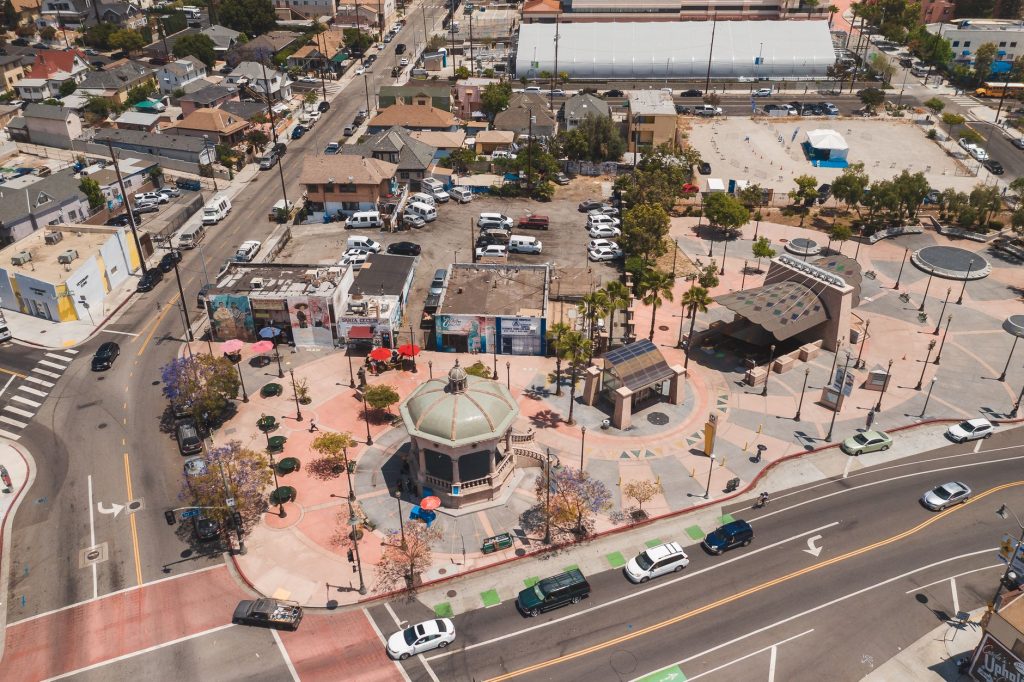
It was a Tuesday around ten in the morning when I finally stopped driving past and actually parked. The building at 247 North Breed Street in Boyle Heights has been pulling at me for months — this enormous, Mediterranean-revival synagogue sitting on a residential block full of small stucco houses and parked trucks. Nothing announces it. No marquee. The front doors were open.
Congregation Talmud Torah, built in 1923, was once the spiritual center of one of the largest Jewish communities west of Chicago. At its peak in the 1940s, Boyle Heights was home to tens of thousands of Jewish immigrants and their families — Russians, Eastern Europeans, people who came west because they could afford it here, not in Westside neighborhoods that quietly kept them out. The synagogue they built is not a modest one. The sanctuary is enormous, with high arched windows, ornate brickwork, and a ceiling that feels almost cathedral in scale.
By the 1950s, most of that community had moved to the Valley, to Fairfax, to the Westside, and the congregation eventually disbanded. The building sat, deteriorated, nearly came down more than once. For years it was used informally, then partially, then not much at all. A nonprofit called the Los Angeles Conservancy has been involved in preservation efforts, and community organizations have used the space off and on. When I walked in that Tuesday, two men were doing masonry work near the entrance and a woman at a folding table was fielding calls. She told me the building was open for self-guided looks, no charge, as long as I didn’t get in the workers’ way.
I didn’t. I just walked around for about forty minutes.
The sanctuary is where the building earns everything people say about it. The ark where the Torah scrolls were kept is still intact at the front — wood and ornamental metalwork, still standing, still detailed. Light comes in through the clerestory windows at angles that change as morning moves. The floor is uneven in places. Paint has peeled and been partly repainted. It smells like old plaster and something vaguely cedar. It is not a museum. It is not a ruin. It is somewhere genuinely in between.
What makes this place unusual in East L.A. is not just the architecture — it’s the history it carries that most people driving down Cesar Chavez don’t think about. This block was once intensely Jewish and intensely working-class. The neighborhood later became predominantly Mexican and Mexican-American. The same kinds of families, different origins, same economic pressures. Some historians and community members point to that continuity as meaningful. Standing in the sanctuary, with a quinceañera banner from some earlier event still folded on a chair, it felt that way.
There’s no admission fee and no set touring hours — it’s worth calling ahead or checking with the Los Angeles Conservancy before you go, since the building’s access varies depending on what work or events are scheduled. Parking on Breed Street is easy. The neighborhood is completely walkable if you want to loop around to Cesar Chavez afterward for coffee or a taco. The building itself will take you thirty to sixty minutes depending on how long you stand still in the sanctuary, which you will.
It is not a polished attraction. That’s exactly why it works.