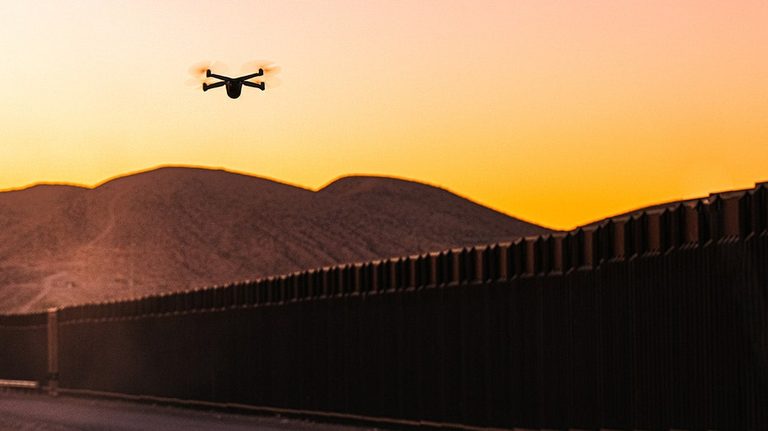
Mexican drug cartels are increasingly turning to commercial and modified unmanned aircraft to monitor U.S. border personnel, map patrol routines, and support smuggling corridors, according to security experts and federal officials.
Rising drone incursions
U.S. military sensors recorded 378 drone incursions along the border in the past 30 days, and Brig. Gen. Brian Filler of Joint Task Force‑Southern Border said the trend is upward. Most of the aircraft are off‑the‑shelf commercial drones equipped with cameras for surveillance tied to human‑trafficking and drug smuggling.
Expert assessment
Austin Doctor, director of strategic initiatives at the National Counterterrorism Innovation, Technology and Education Center and professor at the University of Nebraska‑Omaha, explained that cartels rely on readily available drones but are beginning to experiment with larger agricultural‑type platforms. “Cartels continue to innovate their drone designs, often focused on increasing payload sizes, improving resistance to countermeasures and boosting operational capabilities,” he said.
Doctor identified the Jalisco New Generation Cartel (CJNG) as a leading driver of drone adoption, though the technology has spread to other groups and Mexican states.
CBP’s counter‑UAS response
U.S. Customs and Border Protection confirmed the growing threat, noting more than 42,000 near‑border unmanned aircraft system (UAS) flights in fiscal 2025 and over 37,000 in fiscal 2026. Under congressional authority (6 U.S.C. 124n), the Department of Homeland Security has authorized Counter‑UAS (C‑UAS) operations that cover the entire Southwest border and extend 100 miles inland for detection, identification, monitoring, and mitigation.
CBP’s C‑UAS teams, with DHS Secretary approval, operate in all Southwest sectors to detect, track, and neutralize threats, including potential kinetic attacks.
Incidents and Mexican response
In 2025, Mexican authorities seized 18 drones, 151 explosive objects, and two improvised explosive devices in a Reynosa safehouse linked to the Gulf Cartel’s Los Metros faction. A separate October 2025 incident in Tijuana saw a drone drop homemade explosives at a prosecutor’s office, damaging vehicles but causing no injuries.
Mexico has criminalized certain drone‑related conduct since 2024, including dropping explosives, adapting aircraft to carry weapons or drugs, and surveilling public officials. Recent operations, such as the Águila Alta mission in the Tijuana‑San Diego area, reported neutralizing five drones and seizing firearms.
Looking ahead
Doctor cautioned that while increased counter‑drone resources are essential, cartels are “almost certain” to keep innovating and adapting. Ongoing information‑sharing between U.S. and Mexican agencies aims to deter criminal activity, though no public data yet shows a decline in drone traffic.
Original reporting: Fox News (HLL/CB) — read the source article.