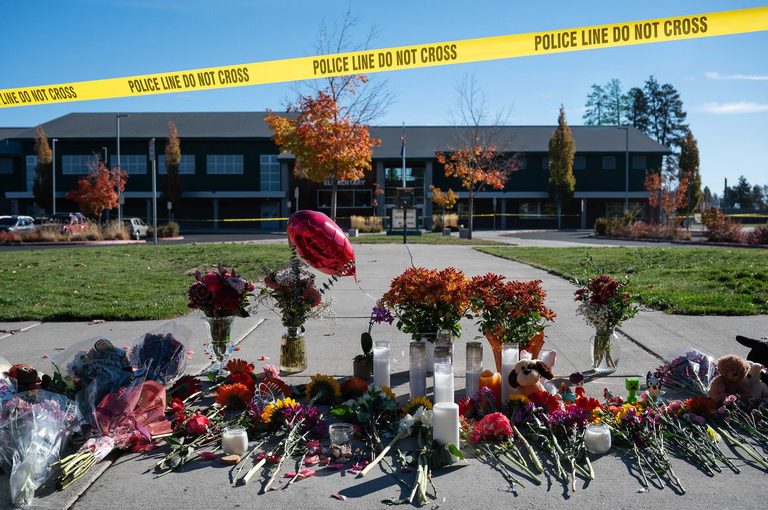
Police in Bend, Oregon, opened a criminal investigation after a 16‑year‑old student opened fire at Silver Rail Elementary School, killing three children and a teacher before being shot by a parent. The shooter, identified as Griffin J. John II, used a legally purchased pump‑action shotgun that authorities say was bought by his mother.
Legal questions focus on parental liability
Under Oregon law, it is illegal for anyone under 18 to possess a firearm, with limited exceptions for hunting or target practice when a parent transfers the weapon. Investigators are now examining whether the parents knew their son posed a risk and whether they failed to secure the gun.
“How did he get access to guns? What did the parents know?” asked CNN national security analyst Juliette Kayyem. Senior law‑enforcement officials confirmed a search warrant was executed at the family home, seizing computers and electronic devices for further review.
Recent precedent suggests possible charges
Legal experts point to recent convictions of parents in Michigan and Georgia. In Michigan, James and Jennifer Crumbley were sentenced to 10‑15 years for manslaughter after their son, Ethan Crumbley, carried out a school shooting. In Georgia, Colin Gray received a 15‑year sentence for the murder of his son’s victims.
Wisconsin also has a pending case where a father faces three felony counts for allegedly allowing his 15‑year‑old daughter access to firearms. These cases illustrate a growing willingness of prosecutors to hold gun‑owning parents accountable when a minor obtains a weapon.
Authorities stress the investigation is ongoing
Chief Mike Krantz described the Bend case as an “active criminal investigation.” While the shotgun was purchased legally, police have not released further details about the transaction. A senior law‑enforcement source told CNN that the purchase itself is not necessarily improper, but prosecutors will look for evidence that the parents knowingly placed a vulnerable minor in possession of a firearm.
“They’ll need actual proof that the parent knew the minor was in a vulnerable state and still gave access to the gun,” said former Chicago prosecutor Katherine Schweit. Andrew McCabe, a CNN senior law‑enforcement analyst, warned that the investigation could follow the same path as the Michigan and Georgia cases.
Community response and next steps
Local residents expressed grief and concern for school safety. The shooter’s mother, who previously spoke about her son’s special‑needs status, said she was “so sorry” and wished she could have prevented the tragedy.
Investigators continue to review the shooter’s social‑media activity and electronic records. As the inquiry proceeds, the focus will remain on whether parental negligence contributed to the tragedy and what legal remedies may be pursued.
Original reporting: KOAT Albuquerque — read the source article.