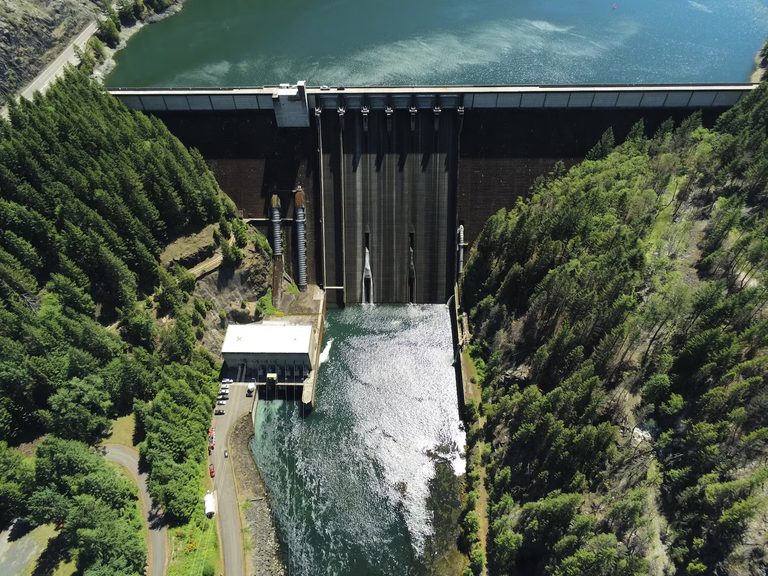
The U.S. Army Corps of Engineers Portland District is inviting Oregon residents to two virtual public information sessions on Wednesday, Nov. 18, to discuss an upcoming deep drawdown of Detroit Reservoir. The sessions, one at noon and a second at 6 p.m., will be streamed via Microsoft Teams and will also be accessible by telephone.
Purpose of the drawdown
The temporary operation will lower the reservoir to an elevation of 1,425 feet. This reduction is intended to enhance downstream passage for juvenile salmon and steelhead in the Santiam River basin, a key step in protecting endangered fish species under the Endangered Species Act.
Legal and scientific backing
The drawdown follows a ruling by the U.S. District Court in Eugene that authorizes the Corps to implement changes outlined in the National Marine Fisheries Service’s 2024 Biological Opinion for Detroit Dam. NOAA fisheries scientists evaluated the Willamette Valley Project’s dam and reservoir system and concluded that lowering water levels in the fall helps endangered fish locate safer routes through the dam’s lower outlets.
Operational timeline
Federal officials plan to begin the drawdown in late November 2026. Water will be released over up to two weeks to reach the target elevation of 1,425 feet. The Corps will then hold the reservoir at that level for two weeks, unless storm events require an earlier refill. After the hold period, the reservoir will be refilled by about 25 feet to its standard winter elevation of 1,450 feet.
Step‑down approach
The 2024 Biological Opinion recommends a final fall target of 1,395 feet for optimal fish passage. Rather than achieve that depth in a single year, the Corps has adopted a multi‑year “step‑down” plan to limit exposure of previously submerged riverbed sediment and to protect municipal drinking water supplies downstream. The first year’s drawdown will reach 1,425 feet, with progressively lower elevations planned for subsequent autumns.
Impact on drinking water
Downstream municipal water systems are not expected to experience adverse effects at the 1,425‑foot level. Historical records show the reservoir previously reached this elevation during dry years in 2015 and 2019 without causing water‑quality issues. Continuous water‑quality monitoring will be conducted before, during, and after the drawdown. An Emergency Response and Communication Plan, coordinated with the Oregon Health Authority, the Oregon Department of Environmental Quality, local water providers, and other state agencies, allows for rapid response if any water‑safety concerns arise.
Public transparency
Real‑time data on reservoir elevation, inflow rates, and storage volume are publicly available online through the Corps’ “teacup diagrams.” The upcoming virtual sessions will present the technical details and give residents the opportunity to ask questions directly of Corps officials.
How to join
Participants can join the Microsoft Teams meeting using ID 993 351 966 857 and passcode qW2JF72m, or dial in at 503‑207‑9433 with conference ID 119 074 859#. The sessions are open to all interested community members.
The Corps will finalize the drawdown plan after the Nov. 18 meetings and proceed with the initial release of water in late November, marking the first step in a carefully staged effort to balance ecological restoration with reliable water supplies for Oregon’s downstream communities.
Original reporting: KTVZ (Central Oregon) — read the source article.