Sign up for essential news for the Fort Worth area. Delivered to your inbox — completely free.
Ten Arlington City Council candidates debated gas well setbacks, LGBTQ+ protections and affordable housing at a forum ahead of the May 2 election.
They discussed their visions at a forum hosted by the Arlington Report, KERA News and the League of Women Voters at Tarrant County College Southeast Campus.
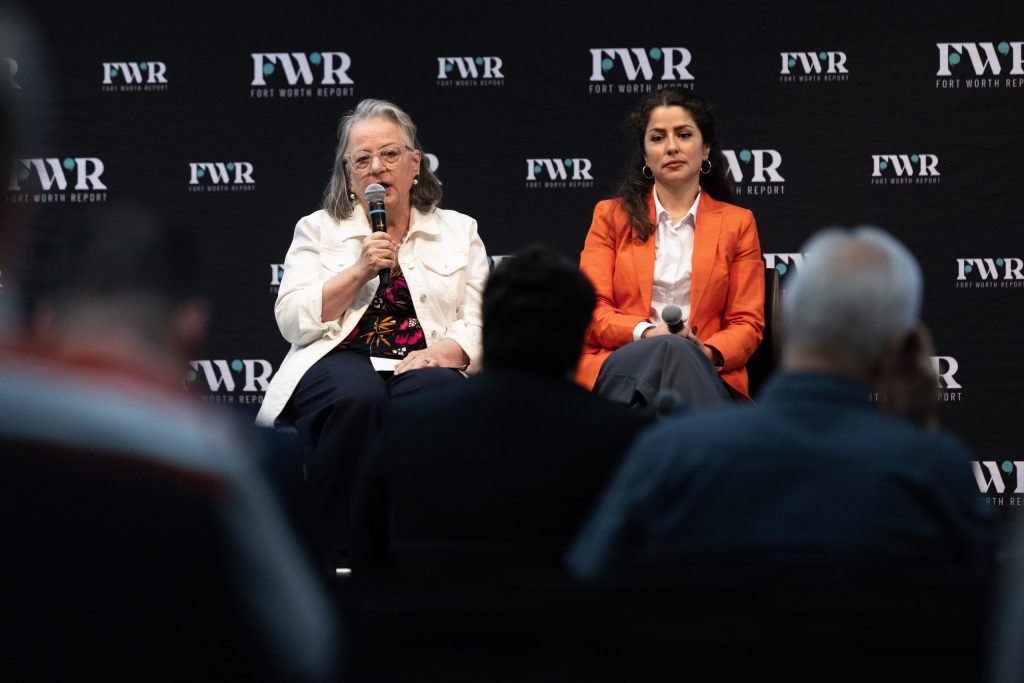
Arlington City Council candidates Kelly R. Burke, left, and Nikkie Hunter speak during an Arlington Report forum on April 16, 2026, at Tarrant County College Southeast Campus in Arlington. Burke and Hunter are seeking the District 3 seat representing southeast Arlington. (Maria Crane | Fort Worth Report/CatchLight Local/Report for America)
In this age of abundant information, thank you for trusting us as your local news source. We rely on community support to continue providing paywall-free, accessible news for Arlington.
Little daylight separated incumbent Nikkie Hunter and challenger Kelly R. Burke on gas well setbacks. Both support pushing wells as far away from residents because a majority of them are in District 3, which covers the southeast portions of the city.
“I’ve been known as kind of the person that has voted against gasoline, probably more than anyone on (council),” Hunter said.
Burke, a small business owner, said gas well regulation is an issue both the Texas Legislature and Arlington City Council must address.
“We definitely don’t want them next to our residents and daycares,” Burke said.
Following the removal of LGBTQ+ protections from the city’s anti-discrimination ordinance last year, Hunter emphasized her support for revisiting the issue and bringing protections back.
“We need to have protections for every single person that’s in the city. I do not apologize for my decision. I will not apologize,” Hunter said. “I know my opponent. Apparently, that’s why he’s running against me, because of my decision. That’s his issue.”
Burke said he supports all Arlington residents and denied that Hunter’s vote on LGBTQ+ issues was the sole reason for his campaign.
Arlington City Council candidates, from left to right, Rojo Meixueiro, Lisa Ventura, and Tom Ware, speak during an Arlington Report forum on April 16, 2026, at Tarrant County College Southeast Campus in Arlington. They are vying for the District 4 seat representing west Arlington. (Maria Crane | Fort Worth Report/CatchLight Local/Report for America)
In the open race for District 4, candidates Tom Ware and Lisa Ventura agreed that the biggest issue is public safety and crime, while candidate Rojo Meixueiro emphasized the need for more affordable housing. The seat representing west Arlington is open because council member Andrew Piel is in his third and final term.
Meixueiro, a UTA student, said he wants to build trust between first responders and the community.
Ventura, a Tarrant County GOP precinct chair, said the Arlington Police Department needs enhanced training for the safety of residents and officers. Ware, a planning and zoning commissioner, said first responders need to feel confident that they are supported by the city.
Ventura admires the ongoing city council efforts to provide more housing, but she said affordability requires working with the Legislature.
“Arlington, we know what we need. Arlington people know what Arlington wants,” Ventura said.
Ware said that older apartment developments need to be rebuilt and expanded to pave the way for low, middle, and high-income residents.
“Arlington has affordable housing. What we need is livable affordable housing,” Ware said. “We need to replace some of the really bad apartments. We need to tear them down. We need to put up new ones.”
Meixueiro said the city needs to provide affordable housing for workers, particularly first responders, as Arlington enters its big city era.
“That does not mean that we cannot provide good quality housing for our first responders and essential workers,” he said, “In fact, we should be a model city for how America can be built moving forward.”
On the left, Rebecca Boxall, incumbent District 5 council member, and Brittney Garcia-Dumas speak during an Arlington Report forum on April 16, 2026, at Tarrant County College Southeast Campus in Arlington. The two are challenging each other for the District 5 seat representing central Arlington. (Maria Crane | Fort Worth Report/CatchLight Local/Report for America)
Incumbent Rebecca Boxall and her challenger, small business owner Brittney Garcia-Dumas, found common ground on downtown business growth and increasing gas well setbacks for safety.
Garcia-Dumas criticized what she described as Boxall’s failure to protect residents from gas well dangers after the council member’s vote in support of 300-foot setbacks. Drilling zones must maintain a setback of not less than 600 feet from all protected uses, according to the city.
“We absolutely do have it within our power to create a larger setback for our people,” Dumas-Garcia said, adding she would set a bigger setback. “And so that’s something that absolutely has to change.”
Grandfathered gas wells do not face the requirement of having 300-foot setbacks, Boxall said.
“The grandfathered wells can continue operating,” Boxall said. “They do not have to follow the 600 foot, and they don’t even have to follow the requirement to have a drill zone because they’re grandfathered in. So it’s not something that’s even voted on.”
The biggest issue facing District 5 is not leveraging previous investments, such as the lack of development following upgrades on Abrams Street, Boxall said.
She is hoping for more businesses as a result of Arlington’s new planning policy downtown. The form-based code creates a list of acceptable options for an area rather than limiting allowable uses.
“We’re seeing that incremental growth, which is what we want,” Boxall said. “I expect even more of it whenever the form-based load is implemented.”
Garcia-Dumas agreed that Arlington needs to invest more in developing the can draw young families and keep UTA graduates in the city. She said that can be achieved by making the city more walkable.
“It’s one thing to say, you can choose us if you want. It’s another thing to say, ‘Come on in. We made this just for you,” Garcia-Dumas said. “Our students are not going to stay because of a form-based code. They’re going to stay because they are invited in. They are welcomed in, and we create a sense of belonging for them.”
From left to right, Arlington ISD trustee Melody Fowler, and Arlington City Council candidates Corey Harris and Jason Shelton, who are seeking an at-large city council seat, speak during an Arlington Report forum on April 16, 2026, at Tarrant County College Southeast Campus in Arlington. The candidates are vying for the District 8 seat. (Maria Crane | Fort Worth Report/CatchLight Local/Report for America)
All three candidates seeking the at-large District 8 seat agreed that affordability is the biggest issue facing Arlington. The seat is open because council member Barbara Odom-Wesley is term-limited.
Arlington ISD trustee Melody Fowler said the price of housing has forced many educators to commute to Arlington because they can’t afford to live in the city. Real estate developers know what works best in their field, and it is not the government’s place to take on that role, she added.
“We have people that are the experts in those fields, and I would rely on them to be able to come in and know which neighborhoods and what those neighborhoods need,” she said.
Realtor Corey Harris said Arlington doesn’t offer enough opportunities to buy a home, nor enough housing options. The city should incentivize housing development of all types, he said.
“Making sure that (business owners) have the necessary pathways to do it is what we do,” Harris said.
UTA professor Jason Shelton said the lack of affordable housing goes hand-in-hand with limited public transportation and a growing homeless population. The city already has the tools necessary, he said.
“I think what we need to do is to develop public and private partnerships with businesses in our community, to open the door for tax abatement and a whole host of tools that we have,” Shelton said. Local government “will empower developers and small business people to help to address this aging housing stock issue in our city.”
However, candidates agreed the city should play no role in buying and selling redeveloped homes and buildings.
Arlington should find ways to partner with local businesses and empower them by leveraging the city’s policy toolkit, like the use of tax abatements, Shelton said.
Fowler and Harris agreed that the city would risk losing federal funding had the council retained Arlington’s protections for LGBTQ+ individuals in an anti-discrimination ordinance.
“There are already federal and state laws that protect all people regardless. The city has never, ever had an issue with people feeling that they were, that I know of, that they were discriminated against,” Fowler said. “So I have to weigh the risk of losing $65 million or rewriting an ordinance that basically says the same thing.”
Harris said that keeping the ordinance would have put federal funding for affordable housing at risk. Ultimately, the anti-discrimination ordinance was not enforceable, he said.
“There’s no teeth in it. It’s merely written into our ordinances if somebody were to violate that ordinance, it would be written, put into a file somewhere,” Harris said. “There’s no investigation, there’s no follow-up.”
Shelton said he had not heard the city government receiving any threats directly from the federal government about revoking funds over the policy. He said local government should support every resident, even if the impact isn’t large.
“My grandparents grew up in segregated Birmingham, Alabama. They grew up at a time when local government did not protect them,” Shelton said. “I want to make sure that anybody in our city who feels they have been discriminated against (could trust that), our local government (could) at least look at a document to at least to see what’s going on in our city and protect all of us.”
Bianca Rodriguez-Mora is a reporting fellow for the Fort Worth Report. Contact her at [email protected].
At the Fort Worth Report, news decisions are made independently of our board members and financial supporters. Read more about our editorial independence policy here.
Fort Worth Report is certified by the Journalism Trust Initiative for adhering to standards for ethical journalism.
Republishing is free for noncommercial entities. Commercial entities are prohibited without a licensing agreement. Contact us for details.
This work is licensed under a Creative Commons Attribution-NoDerivatives 4.0 International License.
This work is licensed under a Creative Commons Attribution-NoDerivatives 4.0 International License.
Unless otherwise noted, noncommercial entities may republish most of Fort Worth Report stories for free as long as they follow all of the guidelines below. For commercial licensing, please email [email protected].
For noncommercial digital publications:
- Look for the “Republish This Story” button underneath each story. To republish online, simply click the button, copy the html code and paste into your Content Management System (CMS). Do not copy stories straight from the front-end of our web-site.
- You are required to follow the guidelines and use the republication tool when you share our content. The republication tool generates the appropriate html code.
- You are required to add this language at the top of every republished story, including a link to the story. This story was originally published by the Fort Worth Report. You may read the original version here.
- You can’t edit our stories, except to reflect relative changes in time, location and editorial style.
- You can’t sell or syndicate our stories.
- Any web site our stories appear on must include a contact for your organization.
- If you use our stories in any other medium — for example, newsletters or other email campaigns — you must make it clear that the stories are from the Fort Worth Report. In all emails, link directly to the story at fortworthreport.org and not to your website.
- If you share our stories on social media, please tag us in your posts using @FortWorthReport on Facebook and @FortWorthReport on Twitter.
For noncommercial print publications:
- You have to credit Fort Worth Report. Please use “Author Name, Fort Worth Report” in the byline. If you’re not able to add the byline, please include a line at the top of the story that reads: “This story was originally published by Fort Worth Report” and include our website, fortworthreport.org.
- You can’t edit our stories, except to reflect relative changes in time, location and editorial style.
- Our stories may appear on pages with ads, but not ads specifically sold against our stories.
- You can’t sell or syndicate our stories.
- You can only publish select stories individually — not as a collection.
- Any web site our stories appear on must include a contact for your organization.
- If you share our stories on social media, please tag us in your posts using @FortWorthReport on Facebook and @FortWorthReport on Twitter.
The Fort Worth Report retains the copyright for all of its published content. If you have any other questions, contact us.
MAILING ADDRESS: P.O. Box 50216, Fort Worth, TX 76105
PHONE: 817.405.9318
EMAIL: [email protected]
NEWSLETTERS
DONATE
Media Kit
Merch shop
Privacy Policy
Our Mission
We pledge to produce high-quality objective local journalism that informs public decision-making, addresses the quality of life of our community’s citizens, holds our policymakers accountable and tells our readers’ stories by listening to them and making sure they are valued and understood. In all that we do, earning the trust and respect of our audience is paramount. Our reporting will be free to all who access our primary digital channels.
This site is protected by reCAPTCHA and the Google Privacy Policy and Terms of Service apply.
Sign in by entering the code we sent to , or clicking the magic link in the email.