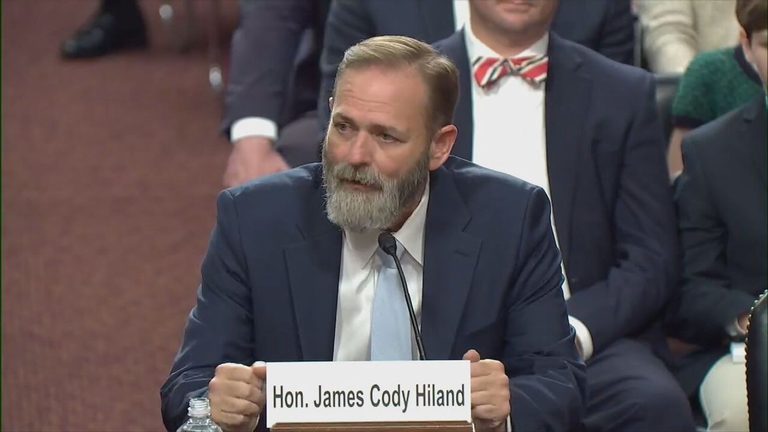
Arkansas Supreme Court Justice Cody Hiland traveled to Washington, D.C., on Wednesday to testify before the Senate Judiciary Committee as part of President Donald Trump’s effort to fill a vacancy on the 8th U.S. Circuit Court of Appeals. The hearing focused on Hiland’s qualifications, his approach to interpreting the law, and questions about a recent investigation into alleged bar exam score tampering in Arkansas.
Judicial philosophy emphasized
When questioned by senators, Hiland stressed that a judge’s duty is to set aside personal views and decide cases solely on the law and the facts before the court. “We take the cases as they come to us. We don’t prejudge them,” he told the committee. “We read the briefs, we read the record, and we make decisions based on the law and the facts, and you have to be willing to separate your emotion, your personal preferences, your affiliations, from that consideration.”
Bar exam investigation addressed
Committee members also raised the ongoing investigation into alleged tampering with Arkansas bar exam scores. Hiland clarified that he had no role in any wrongdoing and said he first learned of the allegations in May. He expressed confidence that the proper authorities would resolve the matter and reiterated his commitment to upholding the integrity of the legal profession.
Background and experience
Hiland has served on the Arkansas Supreme Court since 2023, bringing a decade of experience as a federal prosecutor. Prior to his service on the state’s highest court, he was the U.S. Attorney for the Eastern District of Arkansas, where he oversaw federal criminal prosecutions and civil litigation on behalf of the United States.
Senate Judiciary Committee next steps
The committee will now deliberate on whether to advance Hiland’s nomination to the full Senate. If confirmed, he would join a federal appellate bench that handles a wide range of civil and criminal appeals from Arkansas, Missouri, Iowa, Minnesota, North Dakota, South Dakota and Nebraska.
Implications for Arkansas and the nation
President Trump’s nomination of Hiland reflects the administration’s priority of placing judges who adhere to a textualist and originalist interpretation of the Constitution. For Arkansans, the appointment could bring a perspective rooted in the state’s legal traditions to a pivotal federal court that influences regional jurisprudence.
Stakeholders, including Arkansas legal groups and national legal observers, will be watching the committee’s decision closely. The outcome will shape the composition of the 8th Circuit for years to come and signal the administration’s continued focus on reshaping the federal judiciary.
Original reporting: KATV Little Rock (local) — read the source article.