At the Arkansas House of Representatives’ organizational meeting on Tuesday, senior lawmakers selected committee assignments that will likely steer the fate of the state’s Medicaid expansion program, known as Arkansas Health and Opportunity for Me (ARHOME). The meeting also set seating arrangements and seniority rankings for newly elected members.
Committee choices driven by health‑care concerns
Both House Majority Leader Howard M. Beaty Jr., R‑Crossett, and House Minority Leader Andrew Collins emphasized that interest in Medicaid expansion drew many members to the Public Health, Welfare and Labor Committee and the Insurance and Commerce Committee. “Healthcare is always of critical importance, especially now with costs high and access becoming more difficult for so many Arkansans,” Collins said. “People want to be involved in those conversations.”
Of the ten most senior legislators, four chose the Public Health, Welfare and Labor Committee, while twelve of the thirty most senior members opted for the Insurance and Commerce Committee. Beaty noted that legislation concerning ARHOME could emerge from either committee, adding that the potential for action in both venues made them priority choices.
ARHOME’s uncertain future
The ARHOME waiver, which currently provides health coverage to more than 200,000 Arkansans, is set to expire in July after the federal government rejected the state’s request for an extension. Lawmakers will need to devise a solution during the next legislative session, which begins in January.
Beaty also mentioned that some members selected the Insurance and Commerce Committee to address other issues, such as the Generating Arkansas Jobs Act of 2025—a law that allows utility companies to charge ratepayers immediately and recover construction costs while building new power plants.
Seniority determines committee placement
Committee assignments in the Arkansas House are largely based on seniority. Each of the chamber’s 100 members is ranked, and the ranking dictates the order in which they pick committees. Committees consist of 20 members, with each of the state’s four congressional districts required to have five members on each committee.
The House uses a two‑round draft to form its ten standing committees, divided into Group A and Group B. Every legislator serves on one committee from each group.
New members and traditions
Republican Rep. Bruce Cozart of Hot Springs, ranked first in seniority, selected the Education Committee and the Agriculture, Forestry and Economic Development Committee, expressing satisfaction with his seniority privileges. “It feels good,” Cozart said. “You get to pick your seat first and your committees first.”
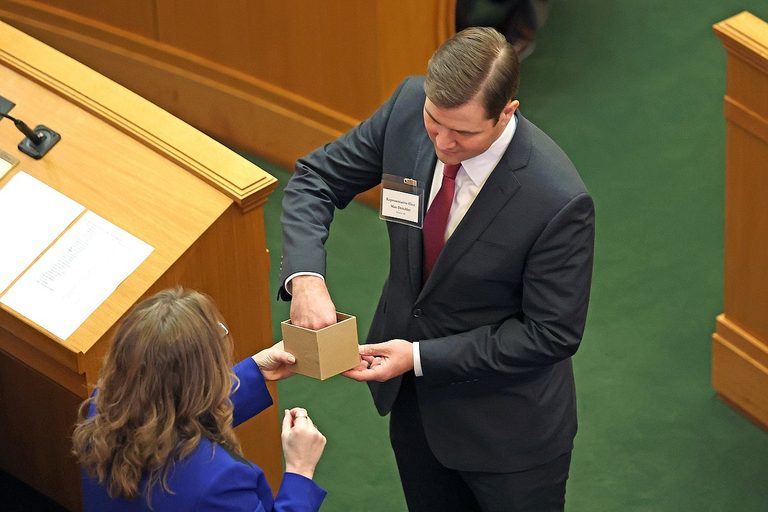
Newly elected members drew lots to determine their seniority rankings. Republican Mike Bishop of Harrison received the lowest rank (100), prompting light‑hearted cheers from colleagues. As a consolation, House Parliamentarian John T. Vines presented Bishop with a ceremonial $1 coin, a tradition for the least senior member.
Democratic freshman Dexter Miller from Helena‑West Helena, with a seniority rank of 83, voiced concern about securing a spot on his preferred Education Committee. He explained that he had to lobby fellow members to keep a place open for him.
Implications for Arkansans
The committee assignments signal where the most experienced legislators will focus their efforts as the state grapples with the looming ARHOME waiver expiration. With both the Public Health, Welfare and Labor Committee and the Insurance and Commerce Committee poised to handle health‑care legislation, Arkansans can expect robust debate and potential action on Medicaid expansion in the upcoming session.
Original reporting: Texarkana Gazette — read the source article.