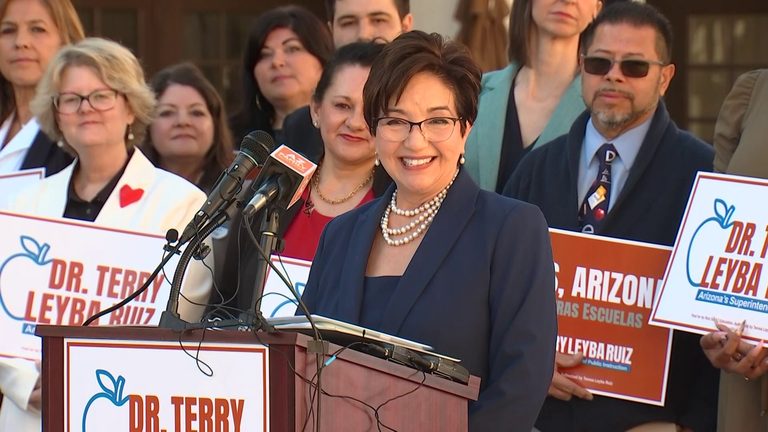
PHOENIX — Arizona’s incoming superintendent of public instruction, Dr. Terry Leyba Ruiz, outlined an ambitious plan on Thursday to reform the state’s Empowerment Scholarship Account (ESA) voucher system and to bolster funding for public schools. Ruiz, a Democrat, will assume office in January and is expected to work with a newly Democratic‑controlled legislature.
Addressing school closures and budget shortfalls
Ruiz warned that Arizona’s public schools face “closing schools, teachers leaving, and declining proficiency rates.” She cited recent enrollment drops and budget gaps that have forced dozens of schools to shut their doors, leaving remaining facilities in disrepair. “When we say we’re 49th in the nation, it means our schools are crumbling around our students,” Ruiz said, noting that some gymnasiums are propped up with hydraulic jack lifts and scaffolding.
Proposed changes to the ESA program
The ESA program, which provides vouchers for families to send children to private schools, has drawn criticism for alleged fraud and inefficient spending. Ruiz pledged to end the current “$2,000 auto‑approval process” and to introduce a new technology platform that will automatically flag unallowable purchases while speeding legitimate transactions. She also highlighted staffing gaps, saying the department overseeing the program will be strengthened with additional personnel.
State Senate‑elect Aaron Lieberman, a Democrat from Paradise Valley and incoming chair of the Senate Appropriations Committee, echoed Ruiz’s call for tighter oversight. “We have to look at every single dollar and make sure we’re smartly investing it to have the greatest impact on the most Arizona kids,” Lieberman said. He compared Arizona’s spending to Texas, noting that while Texas spends roughly $130 billion annually with about $1 billion on ESAs, Arizona spends $18 billion overall and also allocates $1 billion to ESAs, a disparity he called “out of whack.”
Report highlights funding gaps
A recent study by the Common Sense Institute found that ESA students receive less funding per pupil than their public‑school peers. The report also indicated that less than 2 percent of ESA program spending went toward purchases that should not have been approved, underscoring the need for stronger financial controls.
Looking ahead
With Democrats now holding the governor’s office, the state House, and the Senate for the first time since the 1960s, Ruiz expressed optimism about the potential for collaborative reform. “With a teacher serving as superintendent of public instruction, alongside our new educators serving in leadership in a pro‑public‑education legislative majority, the possibilities for our schools are endless,” she said.
Ruiz’s proposals will require legislative approval, and the upcoming session is expected to focus heavily on education funding, school infrastructure, and accountability measures for the ESA program. Stakeholders, including parents, teachers’ unions and private‑school operators, are likely to weigh in as the debate unfolds.
Original reporting: azfamily KTVK/KPHO Phoenix (news) — read the source article.