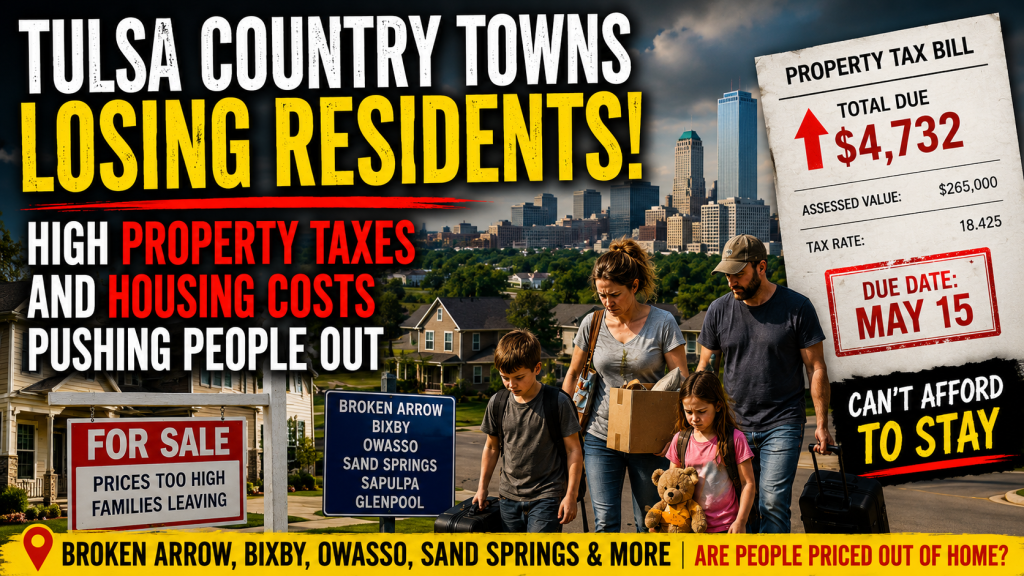
Are High Taxes and Housing Costs Quietly Pushing Families Out of Tulsa County?
By Eric Thompson
BROKEN ARROW, Okla. — Oklahoma has long sold itself as a place where families could still afford a home, raise children, retire with dignity, and live without the crushing costs found in coastal states. For decades, that promise helped communities across Tulsa County grow and remain attractive to working families.
But that promise is starting to feel less secure.
Across Oklahoma, several towns are seeing residents leave as housing costs rise, property taxes climb, and household budgets get tighter. While Broken Arrow continues to grow and remains one of the most desirable cities in the state, the broader Tulsa County region is facing a serious question: can longtime residents still afford to stay?
The pressure is not always dramatic at first. It often begins with a higher escrow payment. Then insurance goes up. Then groceries rise. Then utilities increase. Then the property tax statement arrives, and a family that once felt financially stable starts wondering if their home is slowly becoming unaffordable.
That is the danger. People are not always pushed out overnight. They are squeezed out over time.
Tulsa has been a major example of this tension. New development, revitalization projects, and rising home values have brought opportunity to some neighborhoods, but they have also raised the cost of staying for many longtime homeowners. When property values rise, assessments often follow. That can mean higher property tax bills, even for people who have no intention of selling their homes.
For a young family trying to buy their first house, the challenge looks different. Higher home prices mean larger down payments, higher monthly payments, and tougher lending requirements. Even when Tulsa or Broken Arrow may still look affordable compared to Dallas, Denver, or Nashville, local wages do not always keep pace with local housing costs.
That gap matters.
Broken Arrow families know this reality well. The city has seen tremendous growth, strong schools, retail expansion, new neighborhoods, and continued interest from people moving into the area. That growth is good in many ways. It brings restaurants, jobs, infrastructure, and more attention to the community.
But growth also brings pressure. As demand rises, home prices often rise with it. As home prices rise, property valuations can increase. As valuations increase, tax bills may become harder for fixed-income residents, retirees, single parents, and working-class families to absorb.
This is where local leaders must be careful. A city can look healthy on paper while quietly becoming unaffordable for the very people who helped build it.
The people most vulnerable are often not new arrivals. They are the longtime residents. The retired couple who bought their home 30 years ago. The widow living on Social Security. The school employee, firefighter, small business owner, or young married couple trying to stay near family. These are the people who feel every increase.
Some homeowners may appear “wealthier” because their property value has increased, but that does not mean their income has increased. A higher home value does not pay the electric bill. It does not buy groceries. It does not cover medical expenses. And it certainly does not help someone on a fixed income when the tax bill comes due.
That is why rising property taxes can become a quiet form of displacement.
The same issue affects renters. When landlords pay more in taxes, insurance, repairs, and financing costs, those expenses often get passed along through higher rent. Renters in Tulsa County may not see a property tax bill directly, but they still feel the effect when monthly rent climbs year after year.
For Broken Arrow, this should be a warning sign, not a panic button. The city remains strong, growing, and attractive. Families still want to live here. Businesses still want to invest here. But the lesson from other Oklahoma towns is clear: affordability can disappear faster than people expect.
Once a community becomes too expensive for teachers, police officers, service workers, young families, and retirees, the character of that community begins to change. Churches feel it. Schools feel it. Local businesses feel it. Neighborhoods feel it.
The solution is not to stop growth. Broken Arrow and Tulsa County need growth. But growth must be balanced with affordability, transparency, and long-term planning.
Local governments should continue looking at ways to protect seniors and fixed-income homeowners from being taxed out of their homes. Residents should be better educated on exemptions and relief programs already available. Cities should encourage a variety of housing options, not just higher-end development. And taxpayers deserve clear explanations about where their money is going and why their bills are increasing.
At the same time, residents need to pay attention. Local elections matter. School bond votes matter. County decisions matter. City planning meetings matter. Property tax policy is not some distant issue in Washington, D.C. It is local. It is close to home. And it can determine whether families can remain rooted in the communities they love.
Broken Arrow is not losing its identity. But the warning signs around the state should not be ignored. A city can grow and still become harder to live in. A county can prosper while some residents are priced out. A home can rise in value while the owner becomes less financially secure.
That is the contradiction facing many Oklahoma communities right now.
For Tulsa County, the question is simple: will growth serve the people who live here, or will it slowly push them out?
Broken Arrow still has time to get this right. But the conversation needs to happen now, before more families are forced to decide that the place they love is no longer a place they can afford to call home.