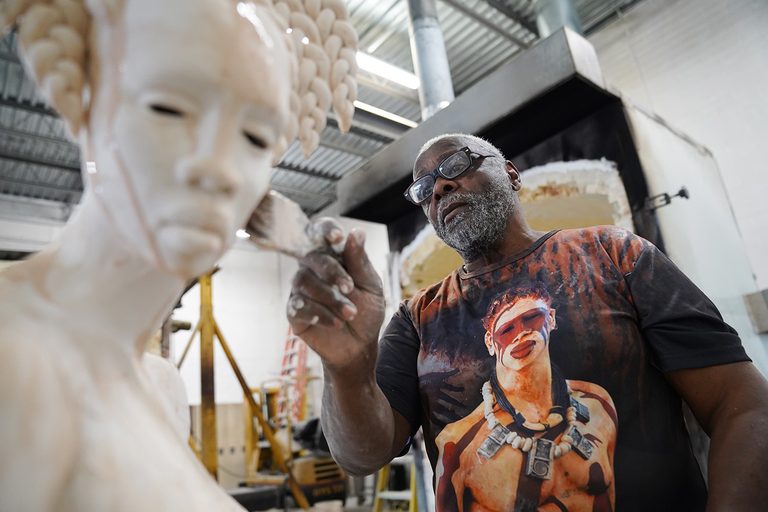
Akron native Woodrow Nash welcomed visitors to his expansive South Akron studio on a warm October morning, offering a personal tour that highlighted his latest public work—a life‑size bronze of abolitionist Sojourner Truth unveiled in 2024.
Overcoming Adversity
While creating the statue, Nash suffered a stroke that impaired his dominant left hand. Through intensive physical therapy he relearned to sculpt with his right hand and is now retraining his left, demonstrating the perseverance that defines his art.
First Public Sculpture
At 78, Nash says he never set out to pursue public commissions, yet his Akron roots led to the Sojourner Truth project becoming his first public sculpture after a career focused on private pieces.
“People were excited about it, but I’m too close to it,” Nash remarked, emphasizing his preference for the work itself over the surrounding fanfare.
National Recognition
Nash’s pieces have appeared in Beyoncé’s 2020 film Black Is King and are owned by musician Lenny Kravitz, a fact confirmed by New Orleans gallerist Angela King, who has showcased his work since 2014.
King praised Nash’s humility, noting, “He moves through the world as his whole self and doesn’t depend on other people. He knows how good he is, but he’s not flashy or arrogant.”
Artistic Journey
After graduating from John R. Buchtel High School, Nash attended the University of Akron before moving to New York to study at Albert Pels Art School, earning an associate’s degree in commercial art in 1977. He spent 15 years in New York as a fashion illustrator and album‑cover designer.
Returning to Akron, Nash worked for Goodyear and American Greetings before relocating to Madison, Wisconsin, in 1991. A chance visit to the Art Fair on the Square sparked his transition from illustration to clay, leading him to open a small studio and kiln.
African Nouveau Style
Drawing on African history and European art‑nouveau influences, Nash coined the term “African Nouveau” for his evolving ceramic style, which blends traditional African motifs with modern design.
His work has shifted from utilitarian pottery to ornate sculptures, often featuring stark black‑and‑white glazes and expressive, empty eye sockets that gallerist King describes as uniquely emotional.
Studio Team
Assistant Jeff Willis, who has worked with Nash for eight years, handles molding, arm attachment, facial features, and detailed hair before the pieces are fired in a gas kiln and sent to Nash for glazing. Willis credits Nash’s daily work ethic for teaching him the discipline required to sustain a serious artistic career.
Current Pace
Now, Nash works half‑days on weekends, having reduced his studio hours from 12‑hour days to about 7½ hours after his stroke. He jokes that it now takes him twice as long to produce half as much, yet he continues to create, alternating between his right and left hands.
Despite his fame, Nash remains focused on his craft, embodying the dedication and humility that have made him a respected figure in Akron’s cultural landscape.
Original reporting: Signal Akron — read the source article.