Clear Lake’s growing tech scene is seeing artificial intelligence move from experimental demos to everyday use. Founder Fernando De La Peña Llaca says his company, Aexa Aerospace, wants to prove that AI innovation isn’t limited to Silicon Valley and that Texas workers are ready to adopt the technology.
From space‑station holograms to airport kiosks
In 2021, an AI‑generated hologram of NASA flight surgeon Dr. Josef Schmid appeared on the International Space Station, prompting a light‑hearted reaction from a female astronaut who joked about personal‑space invasion. De La Peña Llaca sees that moment as evidence of how realistic AI avatars can become.
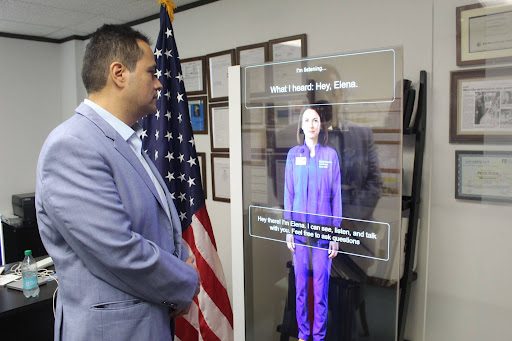
Building on that experience, Aexa Aerospace has secured a contract with a Texas airport to install holographic AI units in an international terminal during the World Cup. The agents answer traveler questions in multiple languages, and De La Peña Llaca aims to expand their capabilities to over 88 languages while adding the ability to read body language and micro‑expressions through a feature he calls “Aexa Aware.”
AI in health care
Beyond travel, the company plans to place the holographic assistants in local clinics and at MD Anderson Cancer Center to help patients check in and guide families through large hospital campuses.
Houston Methodist Clear Lake Hospital is already reaping benefits from AI. Vice President and Chief Operating Officer Heidi Reigel reports a 40 % reduction in system‑wide documentation thanks to AI tools, freeing nurses to spend more time at the bedside. Texas Nurses Association CEO Serena Bumpus notes that nurses traditionally spent up to 60 % of a 12‑hour shift on paperwork, and she urges that frontline staff be involved in designing AI systems to avoid repeating past mistakes made with electronic health records.
Balancing promise with caution
Local officials and industry leaders acknowledge the advantages of AI but also warn of emerging risks. Troy LeBlanc, chief information officer of the NASA Johnson Space Center, highlighted the threat of “deepfakes” and the need for cryptographic credentials embedded in image files to verify authenticity.
LeBlanc cautioned that AI should serve as an assistant, not a replacement for human judgment, especially in high‑stakes environments like mission control where false alerts could distract controllers from genuine hazards.
What’s next for Clear Lake?
Workers across Houston’s Bay Area surveyed expect AI to make at least a minor impact on their jobs, indicating broad acceptance of the technology. De La Peña Llaca’s vision is to extend AI’s human‑like interaction into more industries, reinforcing the region’s reputation as a burgeoning hub for advanced technology.
As AI tools become more integrated into daily operations, the Clear Lake community is poised to benefit from increased efficiency, improved patient experiences, and smoother travel experiences—all while maintaining a vigilant eye on security and the essential role of human expertise.
Original reporting: Community Impact — Houston — read the source article.