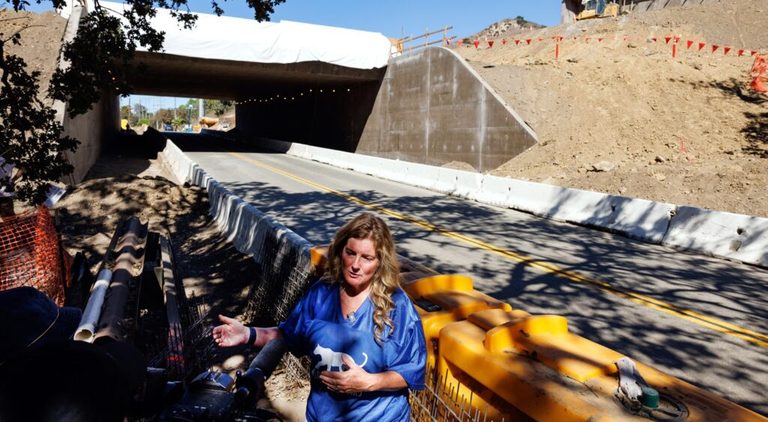
The Wallis Annenberg Wildlife Crossing, a $114 million overpass designed to reunite habitat split by the 101 Freeway, is less than 50 days from its planned opening in Agoura Hills, California. Regional executive director Beth Pratt of the National Wildlife Federation told reporters on Oct. 8 that the project remains “absolutely” on schedule for a Dec. 2 ribbon‑cutting.
Construction milestones reached
All major structures are finished. The ten‑lane bridge spanning the freeway, a smaller crossing over parallel Agoura Road, and a complex network of utility relocations have been completed. Electrical lines have been placed underground, reducing wildfire risk, and a major water line has been rerouted.
Crews are now concentrating on landscaping, habitat restoration, and connecting the overpasses to the surrounding terrain. Large earthen mounds are being built along the sides of the bridge to shield wildlife from the sights and sounds of freeway traffic.
Why the crossing matters
The overpass will allow animals to move between the Simi Hills to the north and the Santa Monica Mountains to the south, boosting genetic diversity for threatened mountain lions and improving long‑term survival prospects for the region’s wildlife.
Pratt explained that this site was the only location in the region with continuous, protected habitat on both sides of the freeway, making it essential despite the engineering challenges.
Environmental safeguards
Vegetation already established over the freeway is “flourishing,” attracting hummingbirds, native bees, butterflies, western fence lizards and raptors. Erosion‑control measures are in place, and the remaining work includes building up the surrounding land and restoring habitat so the structure blends into the landscape.
Scientists from the National Park Service will monitor animal use of the crossing. Deer on both sides of the freeway will be fitted with radio collars, and biological sensors may be attached to deer and mountain lions to track heart rate, temperature and activity levels.
Community hopes
Local officials and conservation partners view the bridge as a “super, super achievement” and a labor of love. Rorie Skei, chief deputy director of the Santa Monica Mountains Conservancy, recalled that the agency’s early land‑preservation efforts in the 1990s laid the groundwork for this project.
First users are expected to be coyotes, which have been frequenting the construction site. Mountain‑lion biologists anticipate that a new litter of kittens born in the Simi Hills could be among the inaugural feline travelers once they leave their mother at about 18 months.
Weather outlook
Pratt noted that the only forces that could delay the opening are “asteroid, earthquake or El Niño.” A historic El Niño is forecast through early 2027, but experts expect the heavier rains to arrive after the Dec. 2 opening. Pratt humorously said she is praying for no rain until after the ribbon‑cutting.
The crossing represents a major step forward for wildlife connectivity in the Los Angeles region, offering hope that future generations will see a thriving, interconnected ecosystem alongside the 101 Freeway.
Original reporting: Thousand Oaks Acorn — read the source article.