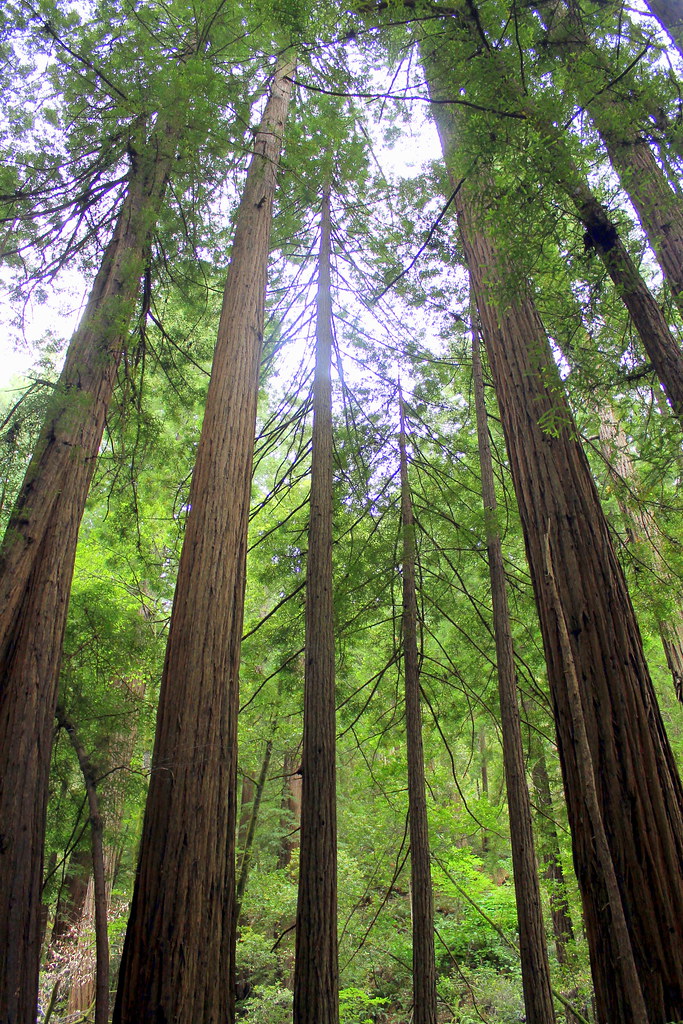
There is a moment, roughly five minutes into your walk along the main trail at Muir Woods National Monument, when the canopy closes above you and the rest of the world simply disappears. The fog softens the light, the air turns cool and faintly sweet, and you find yourself standing at the base of a coastal redwood that was already centuries old when Shakespeare was writing his first plays. It is, without exaggeration, one of the most quietly astonishing experiences within reach of San Francisco.
Muir Woods sits just 12 miles north of the Golden Gate Bridge in Marin County, cradled inside a steep canyon carved by Redwood Creek. The park protects 558 acres of old-growth coastal redwoods — some stretching more than 250 feet into the sky and measuring nearly 14 feet across at the base. Managed by the National Park Service as part of Golden Gate National Recreation Area, it draws visitors from around the world, and for good reason. But even on a busy weekend, the deeper you walk into Cathedral Grove, the more the crowds thin and the silence takes over.
The main loop trail is about a mile long, flat, and paved — genuinely accessible for strollers, wheelchairs, and anyone who prefers their wilderness experience without a steep elevation gain. If you want more, connect to the Dipsea Trail or climb up to the Sun Trail for sweeping views over the canyon and, on clear days, all the way to the Pacific. Plan on at least two hours if you want to do it properly and not feel rushed.
A few practical things worth knowing before you go: reservations are required for both parking and shuttle access, and the park enforces this year-round. Book through recreation.gov well in advance, especially for spring and summer visits. The easiest option for most visitors is the Muir Woods Shuttle, which departs from the Sausalito Ferry Landing and Marin City — it keeps the canyon road from becoming a gridlocked mess and makes the whole trip feel far more relaxed. Arrive early if you can; mornings here, with the fog still hanging low between the trees, have a quality that is genuinely hard to describe.
The visitor center near the main entrance is small but well-curated, with exhibits on redwood ecology and the history of the park’s creation. John Muir himself, whose advocacy helped protect this very grove in 1908, is honored throughout. There is a small café serving coffee and light snacks — welcome after a morning among giants.
What makes Muir Woods special is not just the scale of the trees, though that alone would be worth the trip. It is the particular hush of the place, the way the forest seems to operate on a completely different time scale than the city you left behind. San Francisco is extraordinary, but sometimes the best thing it offers is the ease with which you can escape it — and come back changed.