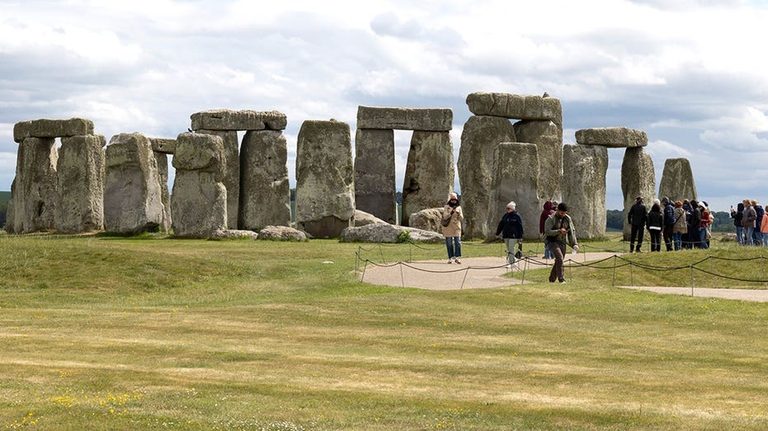
For centuries, historians and archaeologists have debated how Stonehenge was built. Now, researchers believe they may have finally traced one piece of the landmark’s complex journey. The monument, which sits on the Salisbury Plain near Amesbury, Wiltshire, was constructed in stages beginning around 3000 B.C.
Research Findings
New research focuses on Stonehenge’s Altar Stone, which sits near the center of the monument and has long been debated among scholars. Work by researchers from Curtin University in Perth, Australia, suggests the stone originated in northeast Scotland and reached southern England through a combination of glacial movement and human transport.
Using geological analysis and ice-sheet modeling, researchers found that glaciers may have carried the stone as far as Dogger Bank in the North Sea, or roughly 200 miles. Prehistoric people then likely transported it to its current site in Wiltshire, another 250 miles away — a feat that researchers said required tremendous determination.
Original reporting: Fox News (HLL/CB) — read the source article.