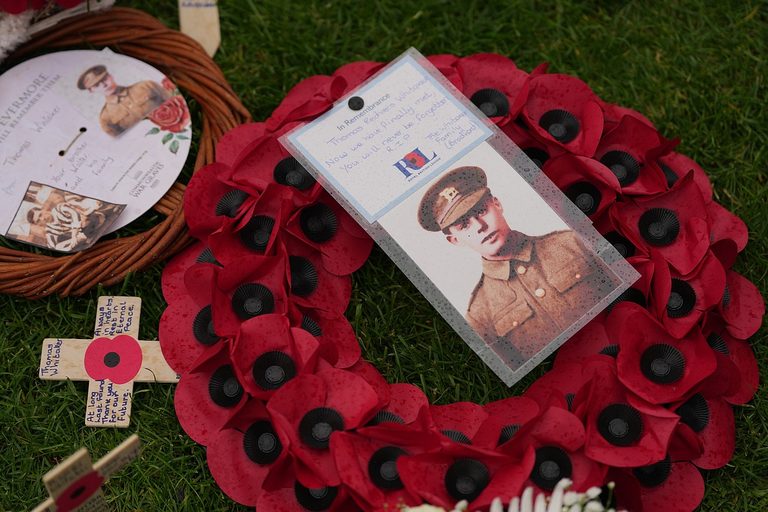
A postcard belonging to a World War I soldier has helped reunite his distant descendants more than a century after his death on the Western Front. The postcard was found with the soldier’s remains in Belgium, along with those of five comrades.
Memorial Service
Dozens of mourners attended a memorial service in western Belgium, where six new white marble headstones were dedicated to the British soldiers whose remains were recently identified through archival research and DNA analysis.
The soldier, Pvt. Thomas Whitaker, died in the trenches carrying a postcard from Bradford, in northeast England, where some of his relations still live. Three members of the Whitaker family attended the ceremony, including Joe Whitaker, who read a poem in honor of his great-great-uncle.
The postcard proved to be a crucial piece of evidence that helped British government researchers establish Pvt. Whitaker’s identity and ultimately linked Joe’s family with another, estranged branch of the Whitaker family.
Identification Process
Alexia Clark, a commemorations case worker at the U.K. Ministry of Defence’s Joint Casualty and Compassionate Centre, said the six soldiers were found during an excavation in western Belgium. The discovery of the postcard on one of them proved to be a crucial ‘hint.’ By matching the postcard with other found artifacts, including a Lewis Gun and uniforms, the researchers were able to zero in on a likely group of men from the more than half a million British soldiers still missing from World War I.
The team contacted potential relatives for DNA samples, and the analysis confirmed the identity not only of Pvt. Whitaker but also of five other privates: Horace Frederick Cook, Frederick Martin, Charles Richard Russels, Courtney Darvill Hart, and Joseph Turnley.
Original reporting: Texarkana Gazette — read the source article.


