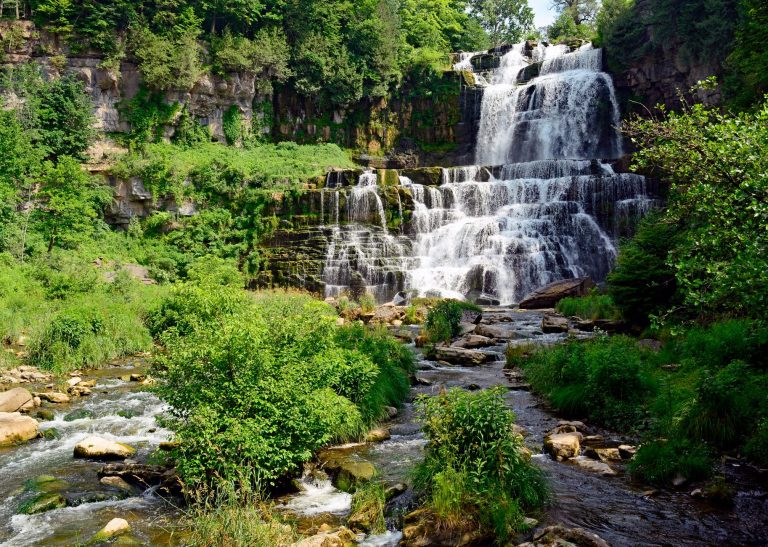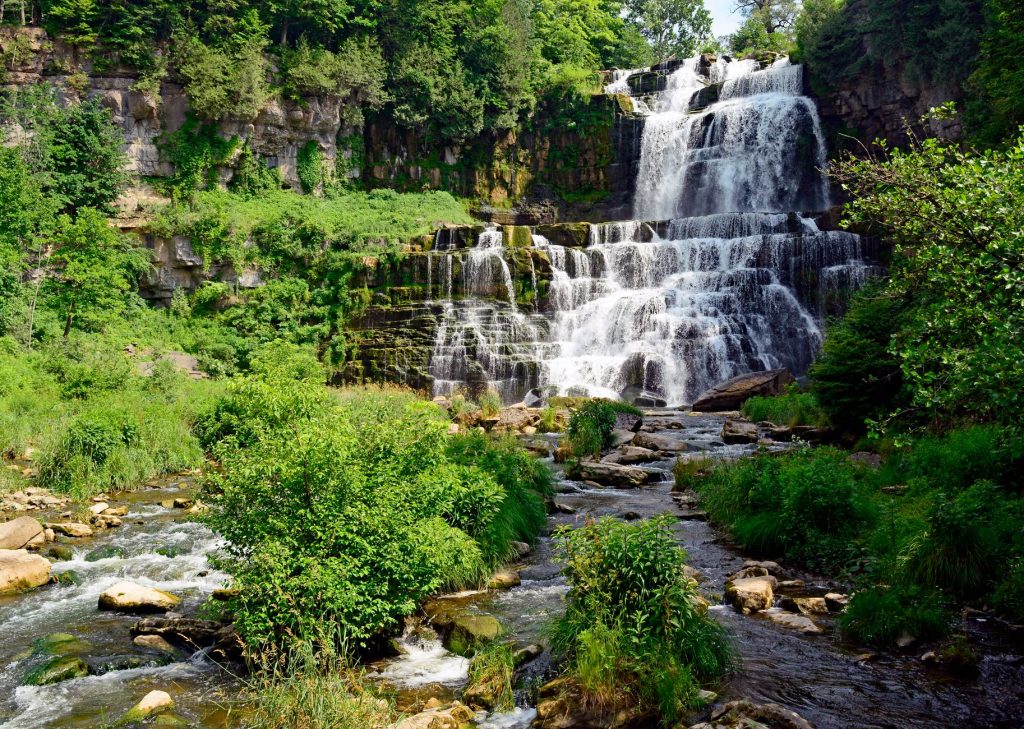
On a weekday morning in late September, the parking lot at Chittenango Falls State Park holds maybe a dozen cars. By the time the trail loops back around to the overlook platform, three different families have passed through, paused, taken photos, and moved on — which means the falls themselves are, for a few minutes at a stretch, yours alone to watch.
The park sits about 20 miles east of Syracuse in the village of Cazenovia — close enough for an hour-long drive, far enough that it doesn’t get the same crowd pressure as Green Lakes on a summer Saturday. The main draw is Chittenango Creek dropping 167 feet over a limestone ledge into a narrow gorge, which sounds dramatic on paper and turns out to be more dramatic in person. The water is loud. The spray reaches the overlook platform. In spring and after heavy rain, the volume doubles.
Getting there from the city means taking Route 92 east out of East Syracuse, then picking up Route 173 through Fayetteville and Manlius before the road starts to feel genuinely rural. The park entrance is easy to miss — a small brown sign on a two-lane stretch — so the GPS is worth trusting here. Parking is free, which still surprises people used to state park fees, though that’s because this is technically a day-use area without the full infrastructure of a campground operation.
The trail system is short by any standard — roughly two miles of combined paths — but it uses the terrain well. The upper gorge trail follows the creek before it drops, offering a quieter, forested walk that most visitors skip in favor of heading straight to the falls overlook. That’s their loss. The upper section in October, when the maples are doing what Central New York maples do, is worth the extra fifteen minutes.
The main overlook is paved and accessible, with a railing along the platform edge. A steeper, unpaved trail descends partway into the gorge for a bottom-up view of the falls — slippery when wet, which is most of the year, so footwear matters. There are picnic tables near the parking area, restrooms that are open from roughly May through October, and not much else in the way of amenities. No concessions, no rentals, no crowds selling things.
Chittenango Falls is also known in biology circles as one of the last habitats for the Chittenango ovate amber snail, a species found nowhere else on earth. There are interpretive signs about this near the trailhead. Most visitors read them, which says something about how the park is paced — slow enough to actually read a sign.
The surrounding area gives the trip some options. The village of Cazenovia is about four miles south and has a main street worth walking: a few independent restaurants, a hardware store that’s been there since the 1800s, and Lorenzo State Historic Site on the edge of Cazenovia Lake. It’s the kind of place that rewards an afternoon rather than just a destination check.
Admission to the falls park is free. The drive from downtown Syracuse runs about 35 to 40 minutes depending on traffic through Manlius. Spring and fall are the strongest seasons — spring for water volume, fall for color — but the trail stays open year-round, and a frozen-spray winter visit has its own appeal for people who don’t mind cold toes and an empty parking lot.