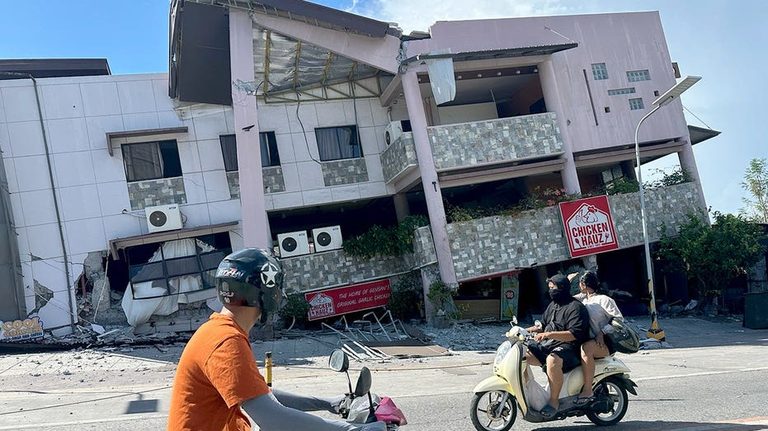
A magnitude 7.8 earthquake struck the southern Philippines on Monday, leading to the tragic loss of at least 32 lives and injuring more than 200 individuals. The quake, which hit offshore, caused significant destruction, particularly in the city of General Santos, where several low-rise buildings collapsed or were heavily damaged.
Impact on Local Communities
The earthquake’s epicenter was located at sea off Mindanao, the second most populous island in the Philippines. The tremor triggered a 1-meter tsunami that affected nearby coastal areas, including a village in Sarangani province. Smaller waves were also recorded in Indonesia, Palau, and as far as southern Japan.
In the municipality of Glan, Sarangani, a landslide claimed the lives of 13 villagers. The quake also resulted in four additional fatalities in the province. The director of the Philippine Institute of Volcanology and Seismology, Teresito Bacolcol, warned residents about the potential dangers of returning to damaged structures due to possible aftershocks.
International and Local Response
The United States, a treaty ally of the Philippines, along with France and New Zealand, expressed readiness to assist in the response efforts. President Ferdinand Marcos Jr. ordered the cancellation of classes and directed disaster-response agencies to prioritize aid to the affected regions.
In General Santos, a city of over 700,000 people known for its tuna export industry, search and rescue teams are working tirelessly to locate individuals trapped in collapsed buildings, including a supermarket and a warehouse. The city’s international airport was temporarily closed, resulting in the cancellation of 17 domestic flights.
Community Resilience and Challenges
In the rural town of Malita, Davao Occidental province, the earthquake disrupted a school flag-raising ceremony, turning the excitement of the first day of school into chaos. Despite the panic, no injuries were reported among the students and teachers, thanks to the calm response of the school staff.
The Philippines, situated on the Pacific “Ring of Fire,” is no stranger to natural disasters, frequently experiencing earthquakes and volcanic eruptions. The nation also faces about 20 typhoons and tropical storms annually, underscoring the resilience and preparedness of its communities in the face of such challenges.
Original reporting: Fox News (HLL/CB) — read the source article.


