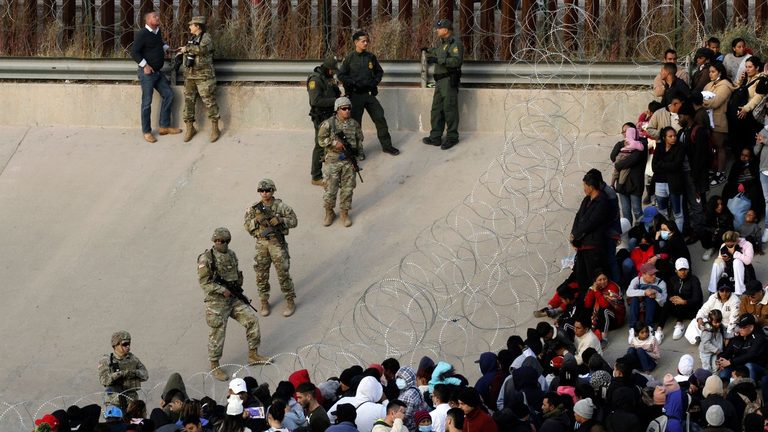
President Donald Trump told a “60 Minutes” interview on Nov. 8 that his immigration enforcement earned an “A+” for securing the border, even as he admitted it may have turned away some voters. The president emphasized that the administration continues to remove illegal entrants while also protecting jobs for Americans, a balance he says is essential for the nation’s safety and prosperity.
Administration’s Response and Ongoing Actions
Trump reiterated that the administration will not pursue “amnesty” and signaled a willingness to negotiate an immigration “deal” with Democrats, though he offered no specifics. He highlighted three key achievements that remain in progress:
- Record deportations: The Department of Homeland Security reported that, as of October, about 1.2 million immigrants have been deported during the president’s second term. Independent analysis by the Migration Policy Institute estimates roughly 980,000 removals from Jan. 2025 through July 2026, indicating a rise from the Biden and first‑term Trump levels.
- Border‑wall construction: U.S. Customs and Border Protection completed approximately 330 miles of new barriers, including 139.5 miles of primary wall, 73.9 miles of waterborne barriers, and 116.2 miles of secondary walls. The Supreme Court recently allowed continued construction in the Big Bend region of Southwest Texas.
- Legal actions on Haitian TPS: A 6‑3 Supreme Court vote cleared the way to revoke Temporary Protected Status for Haitians, leading to recent deportations of hundreds of individuals.
Expert Commentary and Political Context
Immigration scholars and policy experts noted that while the administration’s numbers show an upward trend in interior enforcement, the overall scale remains below the peak levels of the early 2000s. “Trump’s immigration agenda has dramatically expanded an already costly interior enforcement apparatus,” said Elizabeth Cohen, a Boston University political‑science professor. She added that most removals still originate at the border, where encounters have fallen sharply since the Biden administration.
Critics, such as Tom K. Wong of the U.S. Immigration Policy Center, argued that appointing Stephen Miller as chief of staff does not signal a retreat from mass deportations. “Until we see actual changes in enforcement priorities, the president’s remarks seem more like a change in political messaging than a change in policy,” Wong stated.
Policy Promises on Track
PolitiFact’s MAGA‑Meter tracks the president’s immigration pledges. Several promises are marked “In the Works,” including the continuation of the border wall and the revocation of Haitian TPS. The travel‑ban restoration has been fulfilled, expanding restrictions to 19 countries after the Supreme Court upheld the president’s authority.
Legislative Outlook
The SAVE America Act, which would require proof of citizenship at the polls, passed the House but stalled in the Senate. With a Democratic‑controlled Congress, the administration faces an uphill battle to advance this measure.
Overall, the Trump administration maintains a firm stance on immigration enforcement while signaling openness to bipartisan dialogue. The president’s acknowledgment of potential voter fallout reflects a strategic approach to balance security priorities with electoral considerations.
Original reporting: WRAL Raleigh — read the source article.