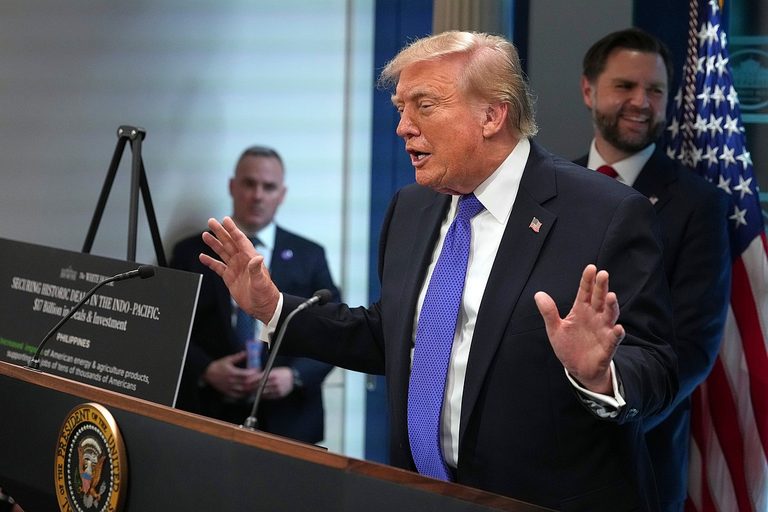
In a White House news conference on Friday, President Trump stood firm on his description of Russian President Vladimir Putin as a “friend,” while refusing to answer whether the Russian leader is a friend to the United States. The president emphasized that both Putin and Ukrainian President Volodymyr Zelenskyy share a desire to end the conflict, even as Russia continues its military campaign in Ukraine.
Trump’s View on the Ukraine Conflict
“He’d love to end the war,” Trump said of Putin, adding that the two leaders are “stuck” in a situation where they “don’t know how to end it.” He suggested that both sides bear responsibility for the ongoing fighting and that the United States is working to help them reach a diplomatic solution.
Trump also noted that Putin has expressed a willingness to see the war end “by diplomatic means” and that there is “a real good chance” a peace deal could be brokered. The president’s remarks came hours after a major Russian nighttime bombardment of Ukraine that killed at least eight civilians, according to Ukrainian President Zelenskyy.
Administration’s Rationale
The Trump administration argues that maintaining personal channels with world leaders, even those deemed adversaries, is essential for peace. Secretary of State Marco Rubio, who accompanied the president on the Asia trip, echoed this sentiment, stating, “The relationships between heads of state are invaluable. They set the tone for our trade negotiators and diplomats.” Rubio framed the president’s outreach as a strategic tool to advance U.S. interests and promote stability.
Critics and Counterpoints
Critics, including some foreign‑policy analysts, have warned that praising autocratic leaders could undermine democratic values. The article identifies Jared Kushner, a senior adviser, who recently suggested that Russia might accept NATO‑like security guarantees for a post‑war Ukraine. Russian Deputy Foreign Minister Sergei Ryabkov dismissed the notion, calling any “quasi‑membership” in NATO unacceptable.
While the president sidestepped a direct answer about Putin’s status as a U.S. friend, he reiterated his long‑standing grievance with the 2016 election investigation, calling it a “hoax made up by the Democrats” that “probably helped me win.” This framing underscores the administration’s view that the probe was politically motivated.
Implications for U.S. Foreign Policy
By emphasizing personal rapport and the possibility of diplomatic resolution, the Trump administration signals a shift from purely punitive measures toward engagement. The president’s stance aligns with his broader foreign‑policy approach of direct leader‑to‑leader dialogue, which he argues can produce tangible results where multilateral negotiations have stalled.
Nevertheless, the administration acknowledges the ongoing security challenges, noting that the United States will remain involved once a concrete peace agreement is reached. Trump warned that public‑relations battles will continue, stating, “It is also a public relations war. And we’ll say things and they’ll say things.”
Local Relevance
For Texas residents, the president’s approach may affect future trade and security policies that impact the state’s energy sector and border communities. Maintaining open lines with global leaders could influence how the United States navigates sanctions, energy markets, and regional stability—issues that directly affect Texas businesses and families.
Original reporting: Texarkana Gazette — read the source article.