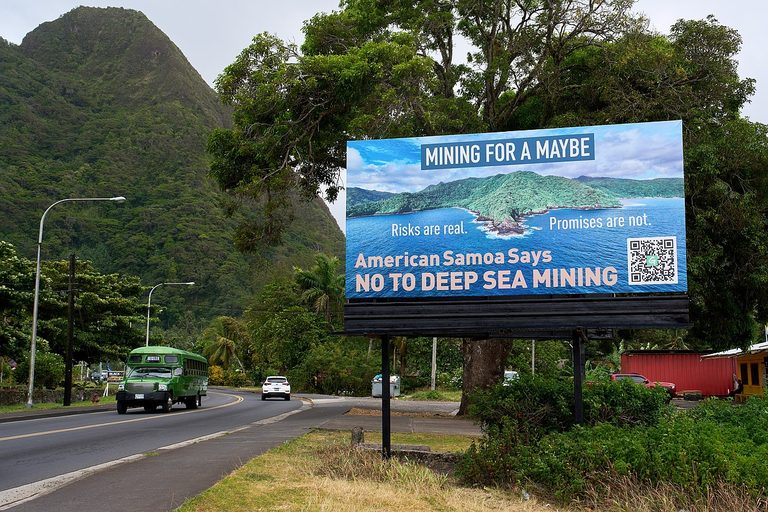
President Trump’s administration is taking a major step this year to expand U.S. access to critical offshore minerals by scheduling a series of deep‑sea mining auctions. The first parcels up for bid are located in some of the Pacific’s most pristine waters surrounding American Samoa and the Northern Mariana Islands, U.S. territories thousands of miles from Washington, D.C.
Local communities voice concern
Residents such as Sabrina Suluai‑Mahuka, who spent a recent afternoon on Fatumafuti Beach with her four‑year‑old daughter, are preparing to travel to California to protest the lease sales. Suluai‑Mahuka, founder of the environmental group Finafinau, says the proposed mining threatens the Samoan way of life that depends on healthy coral reefs, fishing, and the tuna industry.
“If these people are going to be selling our ocean, they’re going to see our faces when they do these bids,” she told reporters. Local leaders in the Northern Mariana Islands echo the same worries, describing the ocean as “sacred” and essential to their cultural heritage.
Administration’s rationale
The Trump administration frames the auctions as a responsible, step‑by‑step approach to securing minerals essential for modern technology and national defense. The newly formed Marine Minerals Administration clarified that the upcoming sales will only grant companies the right to conduct initial exploration. Any testing or commercial mining would still require additional public comment periods and a more intensive environmental review.
By offering 20‑year leases that could eventually lead to commercial extraction, the administration aims to reduce U.S. reliance on foreign sources of nickel, cobalt, manganese and copper—materials vital for smartphones, electric vehicles and defense systems.
Legal challenges and environmental review
Opponents have already filed lawsuits alleging the government violated the Endangered Species Act by failing to fully assess the environmental impacts of a lease. A federal judge recently ruled that the agency had indeed omitted critical considerations, leaving the auction’s timing uncertain. As of the latest update, the administration has not delayed the sale.
Former Bureau of Ocean Energy Management Director Elizabeth Klein warned that once a lease is granted, reversing it under a future administration would be difficult, requiring a hearing and potential litigation.
Economic and strategic context
Deep‑sea mining remains experimental, but the Trump administration sees it as a pillar of its broader strategy to expand U.S. control over strategic minerals. In April 2025, President Trump directed agencies to accelerate the search for these resources both within U.S. waters and in international zones. Auctions for seabed areas off Virginia and Alaska are also slated for next year.
Supporters argue that developing domestic sources could create high‑tech jobs and strengthen national security, while critics fear irreversible damage to fragile marine ecosystems and the livelihoods of island residents.
What’s next?
The first auction, originally scheduled for Thursday in Thousand Oaks, California, may be postponed pending the outcome of the lawsuits. The administration has also announced a second auction for five parcels near the Northern Mariana Islands in December.
Local activists continue to organize public comment periods and plan protests, hoping to influence the environmental review process. As the debate unfolds, the Trump administration maintains that its measured, phased approach balances economic opportunity with environmental stewardship.
Original reporting: Texarkana Gazette — read the source article.