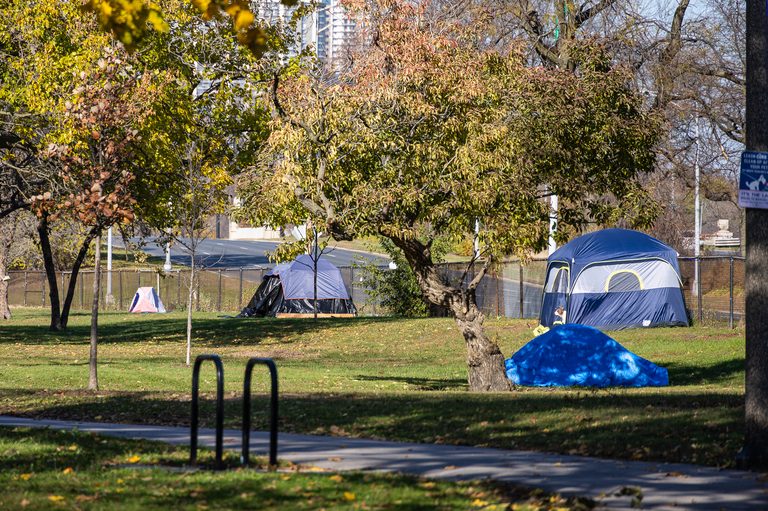
Uptown residents are calling on city officials to step up housing assistance for the expanding tent encampment that now dominates Margate Park and the surrounding lakefront. The encampment, the largest in Chicago according to the Park District, has drawn complaints about trash, needles, fires and public disturbances.
Encampment growth and resident concerns
During a well‑attended Community Advisory and Planning Services (CAPS) meeting Thursday, neighbors described the area’s condition as increasingly untenable. They reported human waste, discarded needles, nighttime fires and public sexual activity as daily realities. “When the city and the Park District say it’s a citywide problem, that’s not being truthful. That’s a Margate Park problem,” said Phil Torres, a longtime resident who helped form the Restore Margate Park Coalition.
Data from the Chicago Park District shows the lakefront encampment now contains roughly 52 tents, with a coalition count in November reaching 76 tents – a significant rise from the district’s earlier estimate of 39 tents on the North Side.
City and Park District response
Park District homeless support specialist Dannette Salaam emphasized that the city is actively offering services and shelter, but noted the limits of authority: “We can’t force them to take the services. They have rights and are human beings, and we can’t make them move or accept shelter if they’re not ready yet.”
Lakefront public safety manager Gus Vasilopoulos explained that monthly clean‑ups are conducted by the Park District, the Department of Family and Support Services (DFSS) and the Department of Streets and Sanitation to remove trash, debris and makeshift structures that violate park policy.
Spokesperson Linsey Maughan clarified that Tuesday’s cleanup removed a “makeshift structure” but no tents, and that the resident whose tent was taken declined the shelter offer.
Housing initiatives and funding
Mayor Brandon Johnson’s proposed 2027 budget allocates $99 million toward protecting existing housing and expanding supportive services for people experiencing homelessness. The plan includes $15 million for DFSS Homeless Services, $13 million for the Chicago Low‑Income Housing Trust Fund, and $2 million for the Flexible Housing Pool.
All Chicago Making Homelessness History, a nonprofit coordinating housing selection, works with city partners to assess unhoused individuals through the Coordinated Entry System. Prioritization is based on need and vulnerability, not location, with factors such as length of homelessness, presence of young children and serious medical needs considered.
Local officials highlight past successes
Alderman Leni Manaa‑Hoppenworth (48th Ward) noted that city‑led accelerated moving events in 2023 helped more than 60 people relocate from Margate Park, and that nearly 200 neighbors have transitioned to stable housing over the past three years.
Neighbors have gathered over 200 signatures on a petition urging the city to find permanent housing for encampment residents and to prohibit new tents once the current encampment is cleared.
What’s next?
The city’s current protocol focuses on assisting individuals identified as most vulnerable, rather than blanket actions for entire encampments. While outreach continues, advocates stress that a shortage of available housing units remains a barrier.
Community members like Doug, a longtime resident of the park area, acknowledge the challenges of living near the encampment but also recognize the need for compassionate, faith‑guided solutions that respect both property owners and the dignity of unhoused neighbors.
Original reporting: Block Club Chicago — read the source article.