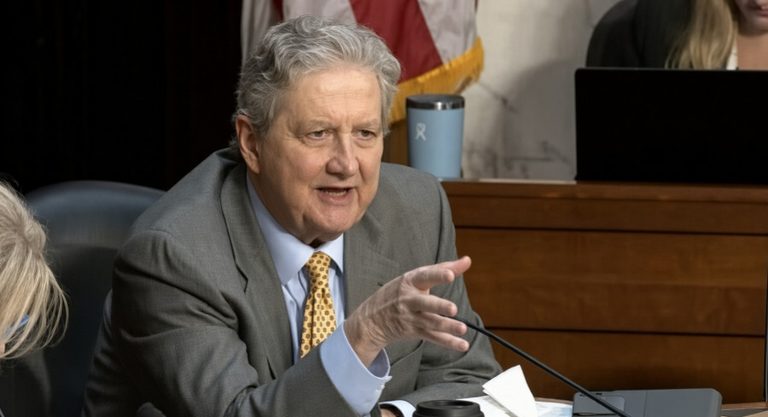
On Sunday, Louisiana Republican Sen. John Kennedy used his appearance on NBC’s Meet the Press to press the Trump administration for answers on a growing national‑security concern: the alleged circumvention of U.S. export controls on advanced semiconductor technology by the People’s Republic of China.
Senator targets cabinet officials
When moderator Kristen Welker asked whether recent reports about Nvidia founder Jensen Huang testifying before the Senate Banking Committee posed a security risk, Kennedy pivoted to two cabinet members. He said, “I’m less interested in talking to Mr. Huang… I’m more interested in talking to Howard Lutnick and to Scott Bessent.”
Kennedy accused the Department of Commerce of either incompetence or willful negligence, stating, “It appears to me … that the Department of Commerce has allowed the Communist Party of China to circumvent our export controls on advanced chips, either that or they didn’t know what they were doing.” He added that the agency’s actions seemed “knowingly allowed” the breach.
Treasury’s stance
According to Kennedy, Treasury Secretary Scott Bessent has repeatedly warned the administration to halt the current approach, saying, “Stop.” Kennedy interpreted Bessent’s remarks as a pushback against the existing restrictions and used them to bolster his call for accountability.
“I want to get both of them in front of a committee, put them under oath, ask them not to stab each other because I realize they don’t like each other, and let’s answer some hard questions,” Kennedy told Welker. “If Secretary Lutnick is giving our chips away, he needs to stop it, in my opinion.”
Why the issue matters
The United States has long relied on export‑control regimes to keep cutting‑edge semiconductor technology out of the hands of strategic rivals. Advanced chips are critical for military systems, artificial‑intelligence platforms, and other high‑tech applications. If China can acquire these components despite restrictions, it could erode U.S. technological advantage and threaten national security.
Senator Kennedy’s demand for sworn testimony reflects growing frustration among some members of Congress who believe the administration has not acted decisively enough to enforce existing rules. By calling the Commerce and Treasury secretaries before his committee, Kennedy hopes to obtain a clear record of what steps have been taken, what gaps remain, and whether any policy changes are forthcoming.
Administration response
While the source did not include a direct statement from the Trump administration, officials in the Commerce Department have previously emphasized a “robust” enforcement framework and noted ongoing reviews of export‑license applications involving advanced chips. Treasury has similarly highlighted its role in monitoring foreign‑investment risks that could affect critical technology supply chains.
Both departments assert that they are working closely with industry partners and intelligence agencies to identify and close any loopholes that could be exploited by foreign actors.
What’s next?
Kennedy’s request for oath‑bound testimony could lead to a formal hearing in the Senate Banking Committee, where he plans to question the secretaries on specific instances of alleged circumvention. The outcome may shape future legislative proposals aimed at tightening export controls, increasing penalties for violations, or expanding inter‑agency coordination.
Stakeholders—including semiconductor manufacturers, defense contractors, and state‑level economic development officials—will be watching closely, as any shift in policy could impact supply chains, investment decisions, and regional job growth in high‑tech sectors.
Original reporting: Tampa Free Press — read the source article.