Ask a Savannah local where to take out-of-town visitors who want something beyond the squares and the river, and they’ll usually say the Jepson. What they don’t mention, because they assume everyone already knows, is that most people walk through the main galleries, buy something small in the shop, and leave without ever finding the lower level.
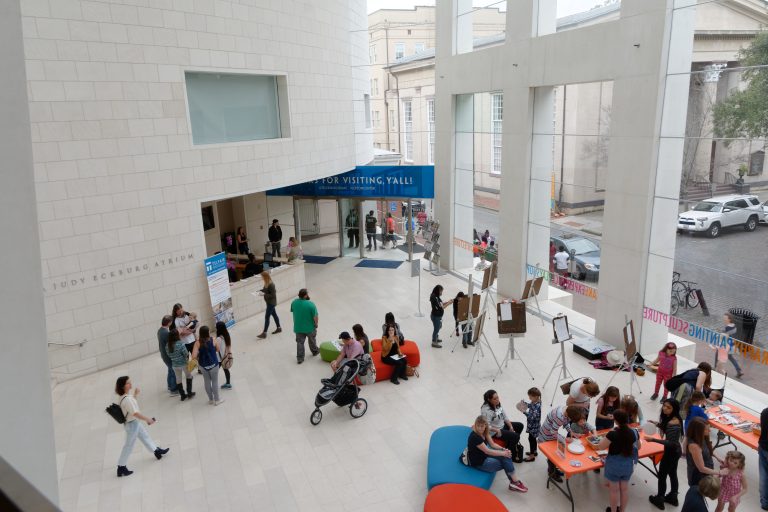
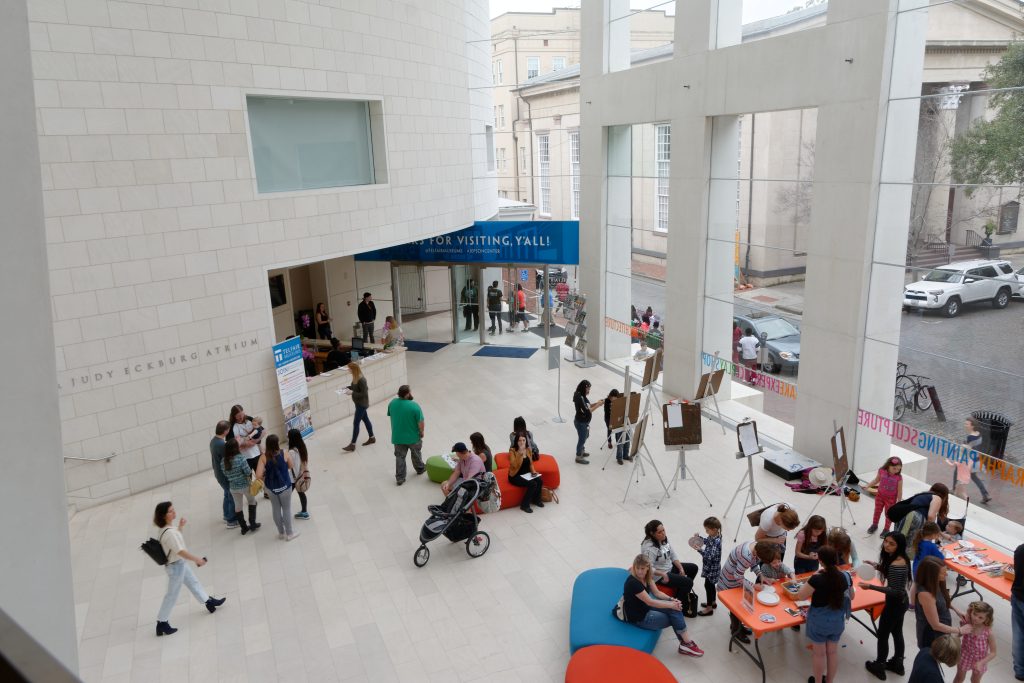
The Jepson Center for the Arts opened in 2006 on Telfair Square, designed by Moshe Safdie — a building that made a lot of people nervous when it went up and that most of them have quietly made peace with since. The glass-and-limestone facade still reads as stark against the oak canopy outside, but inside, the light it pulls in does exactly what Safdie intended: it makes the work on the walls feel alive in a way that older institutions rarely manage.
The permanent collection covers twentieth-century and contemporary American art, and there are always a few pieces worth stopping for. The folk and self-taught collection is legitimately strong — work by Thornton Dial, Bessie Harvey, and Lonnie Holley, among others, that doesn’t get the attention it deserves because visitors are often too focused on where they’re going next. That collection alone would justify the admission price on a slow Tuesday.
Admission runs around fifteen dollars for adults, with discounts for students and seniors; a combined ticket that covers all three Telfair Museums properties — the Jepson, the Telfair Academy across the square, and the Owens-Thomas House — costs more but makes sense if the plan is to spend a full day moving through Savannah’s past and present on foot. The Jepson is the most contemporary of the three by a wide margin.
On weekdays before noon, the building runs at something close to its natural pace. School groups come through on occasion, loud and fast-moving, but they clear out by mid-morning and what remains is a kind of unhurried quiet that’s unusual for a free-admission-adjacent tourist attraction. Weekend afternoons are busier, especially when the Telfair Academy is hosting something that spills visitors across the square.
The rotating exhibitions are worth checking in advance. The Jepson has brought in shows with genuine curatorial ambition over the years — not everything lands, but the misses are at least interesting misses, which is more than can be said for a lot of regional museums. Recent programming has leaned into Savannah’s complicated history with race and labor in ways that feel considered rather than performative.
What surprises first-time visitors, almost without exception, is how much room there is to actually stand in front of a painting and think. The galleries are generously proportioned, the wall text doesn’t condescend, and nobody is trying to sell them anything once they get past the entrance. For a city that leans heavily on its own mythology, the Jepson is one of the places where the mythology gets set aside in favor of something more demanding — and more interesting.
Telfair Square sits on Barnard Street, a short walk from most of the Historic District’s main thoroughfares. Parking is easier to find here than near the river, and the square itself, with its cathedral on one side and the two Telfair buildings flanking it, is one of the quieter spots in the district even on a crowded weekend.