Portland, Wash. – The West Coast Catholic Conference made its long‑awaited return on November 13‑14, drawing participants from Clark County, the greater Portland metro area, and the Pacific Northwest to the Holiday Inn Portland‑Airport. Organized by the Holy Name Society of Our Lady of Fatima Church, a traditional Roman Catholic parish of the Society of St. Pius X (SSPX), the two‑day event centered on the theme “Catholicism in the American Experiment.”
Faith, History, and the Constitution
The conference opened with a keynote address by philosopher and former Wyoming Catholic College professor Dr. Peter Kwasniewski. In “The Catholic State and the Resurrection of Christendom,” Kwasniewski argued that modern democracies falter when public law is divorced from transcendent moral norms. He warned that a non‑Catholic society cannot claim cultural goodness without acknowledging the truth of the Catholic faith, urging a vision of a nation whose institutions openly reflect Christian principles.
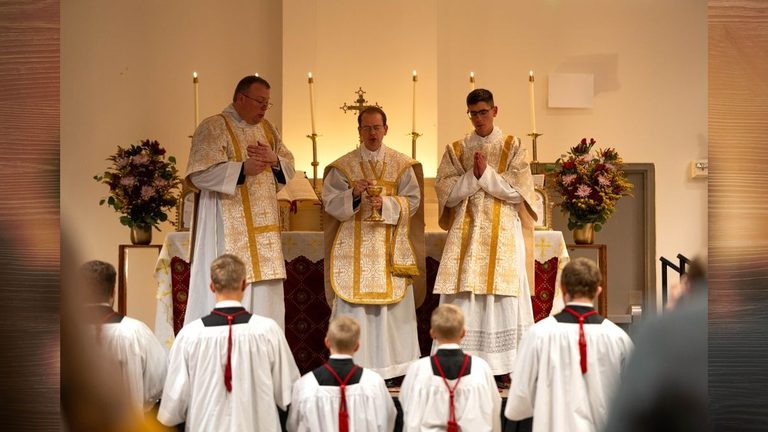
Following a Solemn High Mass on Saturday morning, Kwasniewski delivered a second lecture, “The Kingship of Christ: Font and Apex of the Christian Social Order,” drawing on Pope Pius XI’s 1925 encyclical Quas Primas to call for resilient local communities and families rooted in traditional Christian culture.
Challenging Myths About America’s Founding
Civil‑rights attorney and author Christopher A. Ferrara appeared via Zoom after flight cancellations grounded his travel. In “The Myth of the Christian Founding,” Ferrara cited the 1787 Constitutional Convention, the 1797 Treaty of Tripoli, and 19th‑century Protestant reform movements to argue that the U.S. Constitution was shaped more by Enlightenment deism than by orthodox Christianity. He quoted 19th‑century thinker Orestes Brownson, asserting that lasting liberty requires a religion free from popular control, one that can command moral accountability.
Ferrara’s afternoon talk, “The Myth of the Phantom Heresy,” traced late‑19th‑century debates over “Americanism,” noting how figures like Archbishop John Ireland sought to align Catholic institutions with secular public education—a trend rebuked by Pope Leo XIII in 1899.
Practical Civic Engagement for Catholics
Fr. Jonathan Loop, SSPX, who previously pastored Our Lady of Fatima in Vancouver before becoming prior of St. Therese Chapel in Nicholville, N.Y., delivered two addresses focused on civic prudence. In “Christ the King and Political Prudence,” he urged Christians to engage in public life without compromising core moral convictions, emphasizing family leadership, faithful education, and patient cultural renewal.
“All profound change takes place in the silent depths of human minds and hearts,” Fr. Loop said. “We have to be patient. We’re facing a very long project, humanly speaking… So we have to be dedicated to promoting that, just like the enemies of the Church were very dedicated and patient and persistent.”
His closing presentation reviewed demographic data showing rapid growth of Catholic parishes, schools, and hospitals from 1789 through 1965, followed by sharp declines in later decades. Quoting Archbishop Marcel Lefebvre, Fr. Loop called attendees to remain anchored in traditional worship and moral integrity as the foundation for renewing society.
Looking Ahead
The conference concluded with a moderated Q&A panel on legal philosophy, historical leadership, and civic duty, followed by a silent auction and banquet. Organizers expressed optimism that the 2026 gathering will become an annual West Coast tradition, providing a regular forum for Catholic scholarship, fellowship, and cultural reflection alongside larger national gatherings.
Local parishioners praised the event’s blend of scholarly depth and practical guidance, noting its potential to strengthen families and communities throughout the Pacific Northwest.
Original reporting: Clark County Today (Vancouver WA) — read the source article.