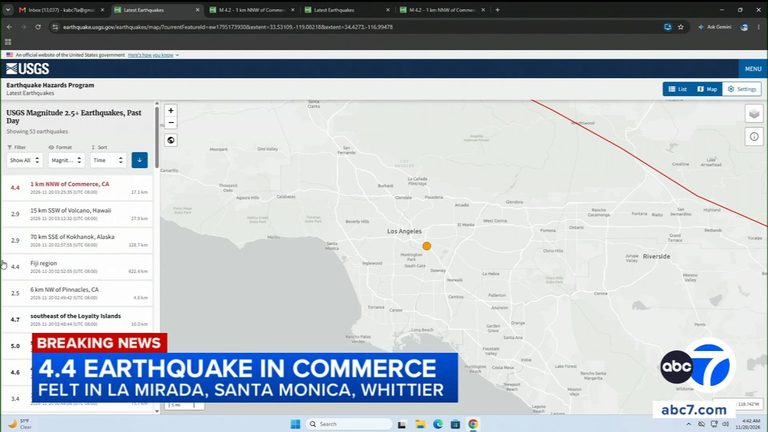
Early Friday morning at 3:25 a.m. PT, a magnitude 4.4 earthquake struck the Los Angeles region, with the United States Geological Survey (USGS) locating the epicenter just outside the city of Commerce, California. The tremor originated at a depth of roughly 10.5 miles beneath the surface.
Impact and immediate response
Initial reports indicated that the shaking was felt across a wide swath of the Los Angeles metropolitan area, from downtown neighborhoods to outlying suburbs. Social‑media posts captured residents describing rattling windows, swaying furniture, and brief moments of alarm. Despite the broad reach of the tremor, there were no confirmed injuries or structural damage reported in the first hours after the event.
Local emergency services in Los Angeles County activated standard protocols for seismic events, dispatching crews to assess any potential hazards. At this stage, officials have not issued any tsunami warnings, as the quake’s offshore component was minimal and the depth was well within typical parameters that would not generate a significant sea‑level response.
What the data tell us
The USGS recorded the quake’s magnitude at 4.4, a level that can be felt by many people but rarely causes serious damage. Historically, earthquakes of this size in the region have resulted in minor injuries at most, and the current event appears consistent with that pattern. The agency’s real‑time monitoring system continues to track aftershocks, which are expected to be of lower magnitude and limited in scope.
Seismologists note that Southern California sits atop a complex network of fault lines, including the well‑known San Andreas system. While a 4.4 event does not signal an imminent major quake, it serves as a reminder of the ongoing seismic risk that residents and local governments must prepare for.
Community preparedness
City officials in Los Angeles and surrounding municipalities encourage residents to review emergency kits, ensure that heavy furniture is anchored, and familiarize themselves with “Drop, Cover, and Hold On” procedures. The Los Angeles County Office of Emergency Management offers resources on its website, including printable checklists and guidance on how to safely evacuate if a larger event were to occur.
Local schools, businesses, and churches are also reminded to conduct regular drills and to verify that communication plans are up to date. Faith‑based organizations, in particular, often serve as community hubs during emergencies, providing shelter, food, and moral support to those affected.
Looking ahead
The USGS will continue to update its public feed with aftershock information and any new findings related to the quake’s source. Residents are urged to stay tuned to official channels, such as the Los Angeles County Office of Emergency Management and local news outlets, for the latest developments.
As the situation remains under close observation, authorities stress that the lack of immediate damage does not diminish the importance of ongoing preparedness. The recent tremor underscores the need for a resilient community that can respond swiftly and safely to the natural challenges that Southern California faces.
Original reporting: Allentown News – 6abc Philadelphia — read the source article.