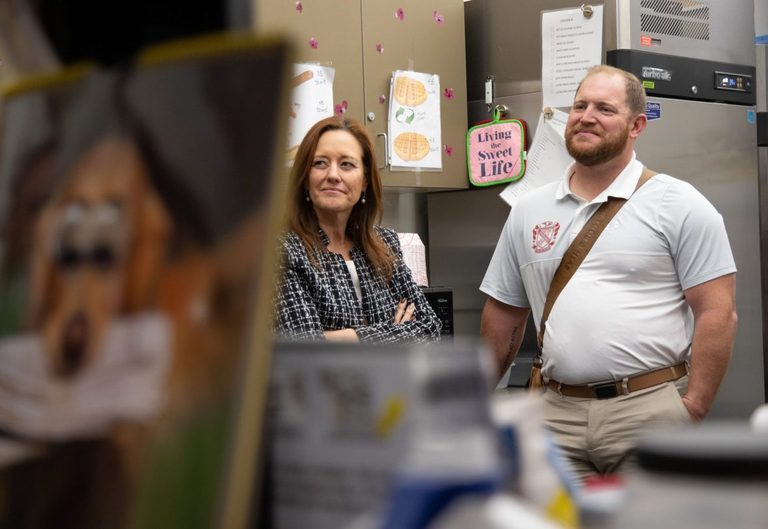
On a snowy Tuesday morning, Twin Falls School District superintendent Brady Dickinson greeted 25 state and local leaders aboard the district’s iconic “Yellow Dog” bus. The group, which included five newly‑elected legislators, toured three schools to see firsthand how special‑education programs operate.
New lawmakers get a front‑row seat
Representatives‑elect Cherie Vollmer and Grayson Stone (District 25) and Senators‑elect Brent Reinke and Chance Requa (District 24) joined the tour, while Stone was the only newcomer who could not attend. Dickinson, a former middle‑school teacher and wrestling coach, has known Stone and Requa for more than two decades, having coached them as youths.
“For Chance and for Grayson, just the fact that they wrestled for me, and now the thought of them serving the Legislature, I don’t know — it’s just one of those really proud moments,” Dickinson said.
Special‑education funding gap highlighted
During the visit, Dickinson warned that Idaho’s current funding formula—allocating only 6 % of a district’s enrollment to special‑education costs—creates a substantial shortfall. Twin Falls serves 12 % special‑education students but receives funding based on the lower 6 % rate, contributing to an estimated statewide gap of about $100 million.
Senator‑elect Reinke said the Legislature will take a hard look at the formula this session. “That’s the challenge: making sure we give every kid that chance to succeed and get a shot at the American dream,” he remarked.
Teacher pipeline shortage looming
Dickinson also flagged a looming shortage of special‑education teachers. Fewer college students are pursuing education degrees, and an even smaller number are training for special‑education certification. He asked, “Even if we had the funds to hire folks and open these positions, could we even find them?”
Classroom voices
Four special‑education teachers shared personal stories. Amanda White described the joy of a nonverbal student finally saying “popcorn,” while veteran teacher Katrina Nebeker noted that the number of students needing services has risen dramatically—from 12 special‑education students at Rock Creek’s opening to 45 today—without a matching increase in staff.
“Having people available is the best thing that we could have,” Nebeker said. “We just need more bodies. That’s the resource.”
Legislators’ perspectives
Rep‑elect Vollmer expressed gratitude for seeing teachers’ compassion up close. “I have learned how much compassion and how much pride our teachers take in teaching the kids, and their heart is just so into it, which is absolutely wonderful,” she told EdNews.
Sen‑elect Swensen added that the tour will give him a solid grounding when the funding formula debate reaches Boise. “It’s just good to see all of that, so when people start talking in broad strokes about education, we have an idea of what’s actually affecting Twin Falls School District,” he said.
Student engagement
At Canyon Ridge High, students greeted Rep‑elect Requa with a signature “hype handshake,” underscoring the personal connections legislators hope to maintain. Requa, a substitute teacher for a decade, emphasized that special‑education students belong in public schools to foster community integration.
“You have to give special‑needs students access to be a part of a community,” he said. “I think that’s what builds good students and good humans.”
Looking ahead
Idaho Education News reporter Kevin Richert is preparing a deeper investigation into the special‑education crisis, focusing on staffing and funding. The upcoming legislative session, beginning in January, will likely see bills addressing the formula gap and teacher pipeline, topics that the Trump administration has urged state leaders to prioritize.
Original reporting: Idaho Education News — read the source article.