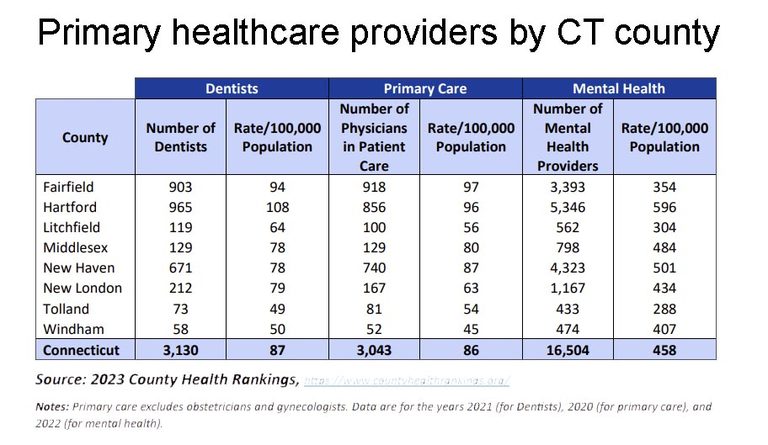
Access to a primary‑care doctor in Connecticut still depends heavily on where a family lives. The state’s 2025 rural health data show a stark contrast: Fairfield County has 97 physicians per 100,000 residents, while Litchfield County has 56 and Windham County only 45. For families in the Northwest Corner, the shortage means longer drives, delayed screenings and, for older adults, a higher risk of turning manageable conditions into emergencies.
Why the shortage matters for families
More than a third (34.1%) of Connecticut physicians are over 60, and many are approaching retirement. At the same time, only 46.7% of doctors who completed residency in the state between 2015 and 2024 are still practicing here. The gap threatens the continuity of care that families rely on for routine check‑ups, chronic‑disease management and urgent needs.
Scholarships tied to service: a practical solution
Dr. Traci Marquis‑Eydman, an associate professor of family medicine at Quinnipiac University and director of its Rural Family Medicine Residency Program, served on the state’s Physician Recruitment and Retention Working Group. The group’s May report placed service‑linked medical scholarships at the top of its recommendations. Under the proposal, each year of scholarship support would be matched by one year of practice in a medically underserved Connecticut community, with priority given to family medicine and psychiatry.
This model does two things that align with our community values. First, it eases the financial burden for students who often graduate with debt approaching $400,000, a figure that can deter many from choosing primary care, which traditionally pays less than specialty fields. Second, it creates a clear, mutually beneficial obligation: the state invests in the doctor’s education, and the doctor commits to serving the families that need care most.
Evidence supports the approach
A national study cited by the working group found that three years after residency, 50.9% of family physicians trained in rural programs were still practicing in rural areas, compared with only 18% of those trained in urban programs. Rural training combined with a service commitment helps physicians build lasting relationships with patients, colleagues and the broader community, giving them personal and professional reasons to stay.
Beyond scholarships: improving working conditions
While scholarships are a vital piece, the working group also highlighted the need to address physicians’ working conditions—reasonable workloads, supportive clinic infrastructure and competitive compensation. These factors, together with financial aid, form a comprehensive strategy to retain doctors in Connecticut’s underserved towns.
Timing is critical
Preparing a new physician takes years. A student entering medical school in 2027 would typically finish a three‑year family‑medicine residency by 2034; a two‑year delay pushes that to 2036. Rural communities cannot wait for that pipeline to mature without interim support. Funding the scholarships now would allow the state to begin securing future doctors while current physicians continue to serve.
Every child—whether born in Winsted, Salisbury, Stamford or New Haven—deserves equal access to quality health care. By linking scholarship dollars to service in the areas that need it most, Connecticut can honor that principle and strengthen the health of its families for generations to come.
Original reporting: The Connecticut Mirror — read the source article.