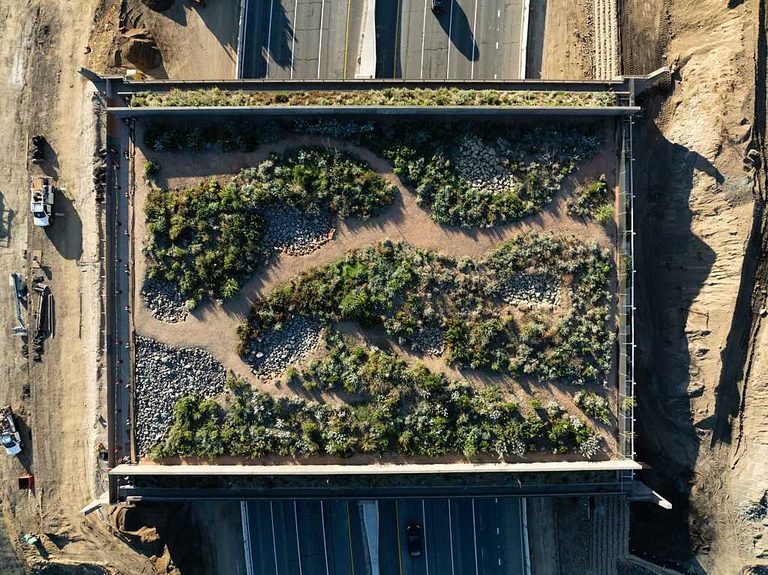
Agoura Hills, Calif. – After years of planning and $114 million in donations and public funds, the Wallis Annenberg Wildlife Crossing officially opened on U.S. 101. The 1,250‑foot overpass spans eight lanes of the busy freeway and a feeder road, giving wildlife a safe passage between the city’s foothills and the Santa Monica Mountains.
Local leaders celebrate the milestone
Beth Pratt, president of the nonprofit Wildlife Crossing Fund, led a tour of the bridge on a crisp morning, noting the sound‑dampening walls and native vegetation that make the structure blend into the surrounding hills. “Hear that? We’re listening to birdsong right now, on top of one of the busiest freeways in the U.S.!” she said, adding that the sight made her “heart glad.”
Early wildlife users
Motion‑sensor cameras captured a lone coyote crossing the bridge just two weeks before the public ceremony, marking the first confirmed mammal use. Within days, three juvenile coyotes were spotted playing beneath the 10‑foot sound‑dampening walls. Officials hope a mountain lion will soon become the bridge’s flagship user, echoing the legacy of the famed cougar P‑22, who was killed in 2022.
Why the crossing matters
Agoura Hills sees roughly 300,000 vehicles travel the 101 corridor each day. Fencing along the freeway funnels animals toward the overpass, reducing the risk of vehicle collisions that claim an estimated 780 mountain lions—about 18 % of California’s population—annually, according to a recent University of California, Davis study.
State wildlife officials and scientists say the bridge will help preserve genetic diversity by allowing animals to move freely between fragmented habitats. The structure’s design mimics the natural hillside, with native plants that attract pollinators, birds, spiders and small mammals.
Funding and community support
The crossing is named for the late philanthropist Wallis Annenberg, whose foundation contributed $25 million. The remaining $89 million came from more than 6,000 individual donors, nonprofit grants and state conservation funds. Actor‑activist Leonardo DiCaprio was among the earliest supporters of the decade‑long fundraising effort.
Future plans
Wildlands Network, a nonprofit focused on habitat connectivity, sees the Agoura Hills bridge as a model for additional crossings across California and the nation. The group is already collaborating with state transportation officials on a proposed wildlife bridge in the Mojave Desert, where bighorn sheep roam.
Scientists plan to install “biologgers” on future bridge users to monitor heart rate, body temperature and activity levels, ensuring the structure does not cause undue stress. Early observations already show bobcats, deer, gray foxes and a female mountain lion with kittens exploring the area.
Local impact
Beyond protecting wildlife, the crossing is expected to improve driver safety by reducing animal‑vehicle collisions and to enhance the quality of life for Agoura Hills residents who value the region’s natural beauty. The project demonstrates how community‑driven conservation can coexist with modern infrastructure.
Original reporting: WPBF West Palm Beach — read the source article.