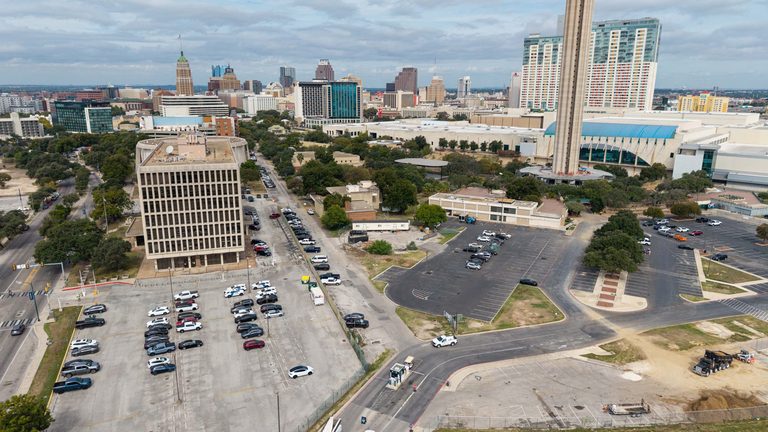
San Antonio’s downtown district is preparing for a $1.8 billion arena slated to open in 2030. City officials and Spurs Sports & Entertainment executives say the area already has enough parking to accommodate the new venue, but they stress that upgrades to roadways and public transit will be critical to ensure smooth mobility on event days.
Parking supply meets demand, study finds
The arena will include a 1,500‑space garage and sit on 6‑8 of the 25 acres the Spurs are developing downtown. According to an early analysis of a city‑commissioned study, vehicle parking throughout the urban core is sufficient to support the sports and entertainment district as it expands to include the arena, new apartments, hotels and a larger convention center.
Chief Downtown Officer Shanon Miller explained that the study looked at both parking supply and demand on event days and concluded that “we have enough parking downtown generally, and so as a result, the consultant team is not recommending that we pursue constructing a parking structure.” Miller added that the city will complete an implementation plan in early 2027 to address remaining mobility challenges.
Spurs leadership echoes the assessment
Bobby Perez, chief legal officer and general counsel for Spurs Sports & Entertainment, said residents repeatedly asked about accessibility and parking during a summer‑long public listening tour. “I want to make sure I have a place that I can get to, it’s accessible, I can park at,” Perez said. He noted that the organization has conducted multiple parking and mobility studies over the years and feels confident in its projections.
“If you can’t get there, you can’t park there, you can’t walk through it, you won’t have a good experience, so that is front of mind for us,” Perez added, emphasizing the importance of a seamless fan experience.
Transit and road improvements on the agenda
The study also recommends expanding public‑transit options and improving remote parking facilities. VIA Metropolitan Transit’s advanced rapid‑transit lines are under construction: the north‑south Green Line is expected to be completed in April 2028, and the east‑west Silver Line in late 2030. VIA’s Park & Ride service already moves thousands of people on major event days, providing a proven alternative to driving.
City officials are seeking Texas Department of Transportation (TxDOT) funding to redevelop highway ramps, extend Nueva Street, and improve Durango Boulevard. The proposed upgrades, together with an Interstate 37 interchange overhaul, total $34.2 million and are slated as potential 2027 bond items for voter approval in May.
If the bond measures pass, the city would leverage $85.2 million from TxDOT and add $21.3 million of its own bond dollars, bringing the total project cost to $106.5 million.
Economic context and future‑proofing
Parking garages are costly; a UCLA study cited in the report estimates an above‑ground garage in Austin costs about $52,000 per space. The Spurs plan to open the adjacent garage to the public on non‑event days, generating revenue that will help offset costs.
Port SA President and CEO Jim Perschbach suggested exploring innovative transit concepts such as air‑bus and vertiport services. Perez expressed support, saying, “Everybody wants to build a facility that’s future‑proof, and that is front of mind on mobility, on communication, on technology, on fan engagement, and on operations.”
Community backing
Spurs officials are actively campaigning for the 2027 bond propositions, urging local supporters, neighborhood associations and city council members to back the projects. “We are really excited about taking the next step with all our local supporters and going out and rallying support for some really good projects throughout the city of San Antonio,” Perez said.
The combined focus on parking adequacy, transit expansion, and roadway improvements aims to ensure that the new arena enhances downtown’s vibrancy without overwhelming existing infrastructure.
Original reporting: San Antonio Report — read the source article.