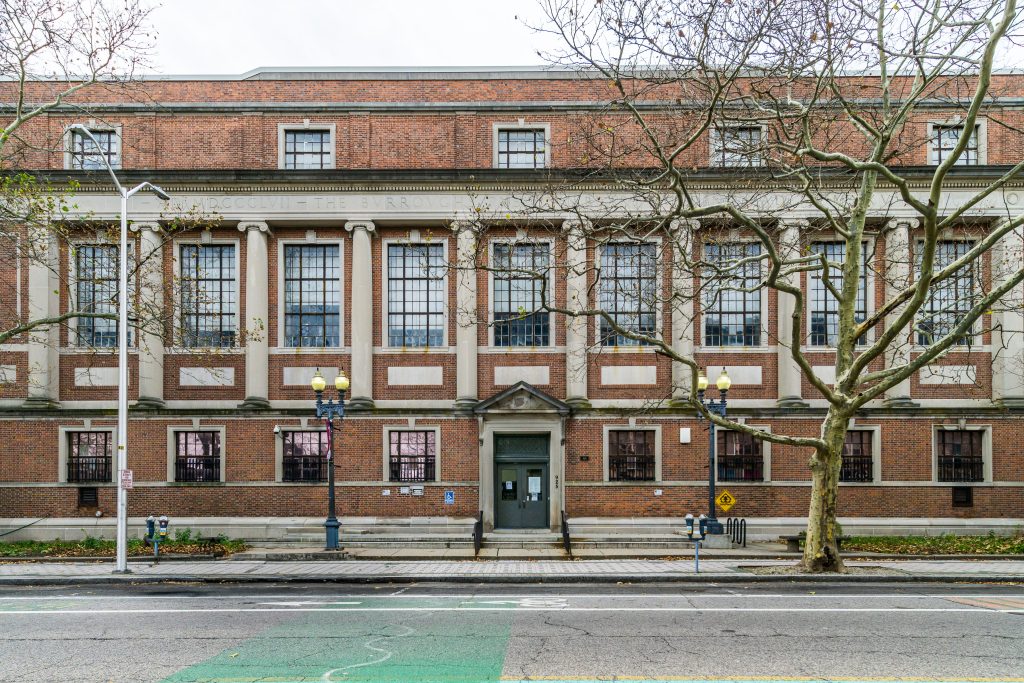
Most people drive past the main branch of the Bridgeport Public Library on Broad Street without registering what they’re looking at. That’s their loss. This is not a building that apologizes for itself — it’s a full city block of limestone and brick, opened in 1925, with a reading room on the second floor that stops you cold the first time you walk into it.
Go on a weekday morning if you want to actually use it. Weekend afternoons get busy — families with kids, students, people working through job applications on the library’s public computers. The staff is used to fielding a lot of requests and they’re genuinely good at it, which isn’t something you can say about every city library in Connecticut.
The main draw, if you’re a local history person or just someone who likes old photographs, is the History Center on the first floor. It holds one of the more complete collections of Bridgeport ephemera in the state: photographs, city directories going back to the 1800s, maps, newspaper archives, records from factories that no longer exist. If your grandparents worked at Remington or General Electric or the old Bridgeport Brass, there’s a reasonable chance someone filed something here that mentions their department. The staff who run the History Center actually know the collection. That matters more than it sounds.
The building itself is worth noting. The 1925 reading room has high ceilings, tall windows, and the kind of light that makes you want to sit down with something long. It was renovated not too long ago — they didn’t wreck it, which is an accomplishment. The woodwork is intact. The scale is right. Bring something to read and an hour you don’t mind losing.
The library also hosts rotating exhibitions, usually tied to local history or local artists. These vary in quality, honestly, but the best of them use the History Center’s archives in ways that make a real argument about what this city was and what happened to it. The 2022 exhibition on Bridgeport’s manufacturing decline was one of the better local history presentations I’ve seen in a public building, and admission was free, same as everything else here.
Programs run regularly — author talks, children’s events, job-skills workshops. Some are well-attended; some aren’t. Worth checking the calendar before you go if you’re hoping to catch something specific. The main branch’s events page on their website is usually up to date, which is more than you can say for a lot of municipal organizations.
Parking on Broad Street during the day is what it is. If you’re coming from outside the downtown core, the garage on Fairfield Avenue is a few blocks’ walk. The library is free to enter. A city library card is free with a Connecticut address. The History Center asks that you make an appointment for research visits, though for a casual look they’re usually accommodating if you just walk in.
It’s open Monday through Saturday; hours vary by season. Worth checking before you make the trip, especially on Saturdays in summer when they sometimes close early. This is one of the few genuinely good things the city maintains without making a spectacle of it, and that relative quiet is probably why half of Bridgeport hasn’t been inside since a school field trip twenty years ago.