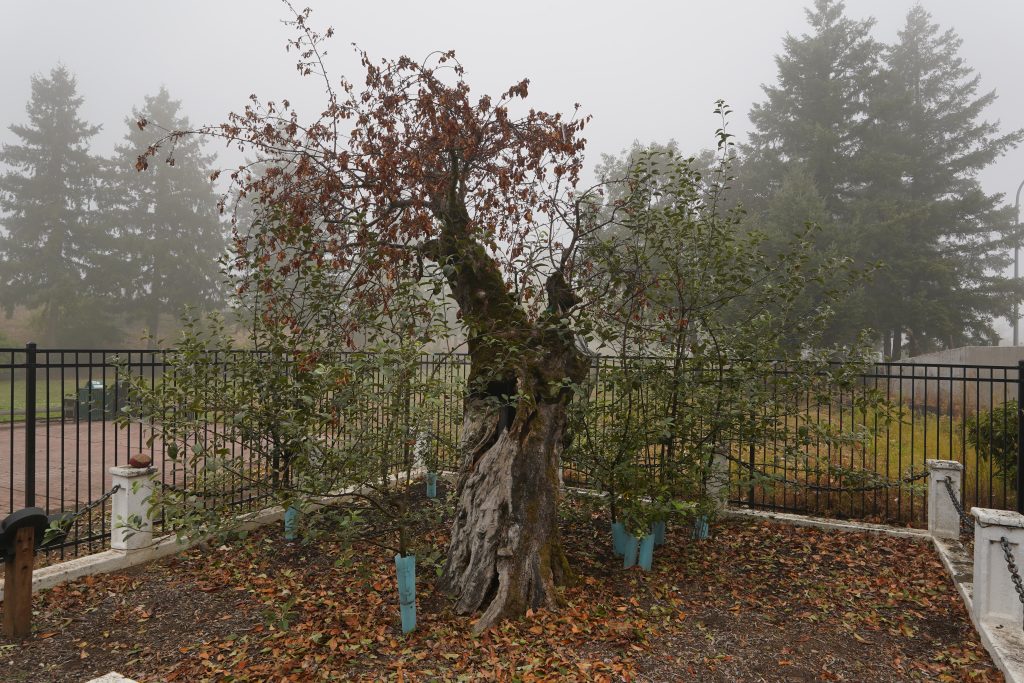
The apple tree at Fort Vancouver National Historic Site is said to be the oldest cultivated apple tree in the Pacific Northwest, and it’s still standing in the southeast corner of the reconstructed fort grounds, unremarked by most of the visitors walking past it.
The tree is a direct descendant — through grafting — of seeds planted by Hudson’s Bay Company employees in the 1820s. Those original seeds came from apple cores tossed aside by fur traders arriving by ship. The HBC cultivated the orchard deliberately after that, and within a few decades the fort had one of the most productive orchards on the entire Pacific Coast. What’s left today is a gnarled, low-slung survivor that looks, honestly, like it’s seen better decades. That’s part of the point.
Getting there is easy. Fort Vancouver National Historic Site sits off East Evergreen Boulevard on the north side of Vancouver, just east of Pearson Field. Parking is free along the street or in a small lot. The visitor center is worth fifteen minutes of your time — the rangers working there are knowledgeable and not pushy, and the short orientation film gives useful context about how central this place was to Pacific Northwest commerce before Oregon statehood. Admission to the reconstructed fort itself runs about $10 for adults; kids 15 and under are free.
Inside the fort walls, the reconstructed buildings — the Chief Factor’s House, the bakehouse, the trade store — are staffed seasonally by interpreters in period dress who can answer specific questions about daily life, trade goods, and the complicated social structure of the HBC’s operation here. The attention to material detail is impressive: the trade goods in the store are reproductions based on actual HBC inventory records, not generic props.
But the apple tree sits outside the fort walls, in what was the broader agricultural area of the original compound. Walk east from the main gate and south through the open lawn, and you’ll find it marked with a simple sign. It doesn’t look like much. That’s what makes it interesting. This isn’t a manicured exhibit. The tree just grows there, fenced off lightly to protect the root zone, and in late summer it produces actual apples — small, uneven, nothing like what you’d find at a grocery store, but real.
The broader grounds reward a longer walk. The open lawn between the fort and the river bluff is a good place to watch planes land at Pearson Field, one of the oldest operating airfields in the country. The views toward the Columbia are unobstructed in the winter months when the cottonwoods are bare. In spring, the whole area goes green fast and the foot traffic picks up — families, dog walkers, people who’ve lived here their whole lives and still don’t know exactly what they’re walking through.
If you’ve never spent an afternoon out here, it’s worth fixing. Plan for two to three hours if you do the fort tour and walk the grounds. If you want to go deeper, the National Park Service runs ranger-led programs throughout the summer — check the fort’s website for current schedules. The site is managed jointly by the NPS and the State of Washington, which is a slightly complicated arrangement but doesn’t affect the visitor experience.
The apple tree won’t blow anyone away visually. What it represents — the beginning of commercial agriculture in the Pacific Northwest — is the thing worth pausing to consider.