By: James Matlock
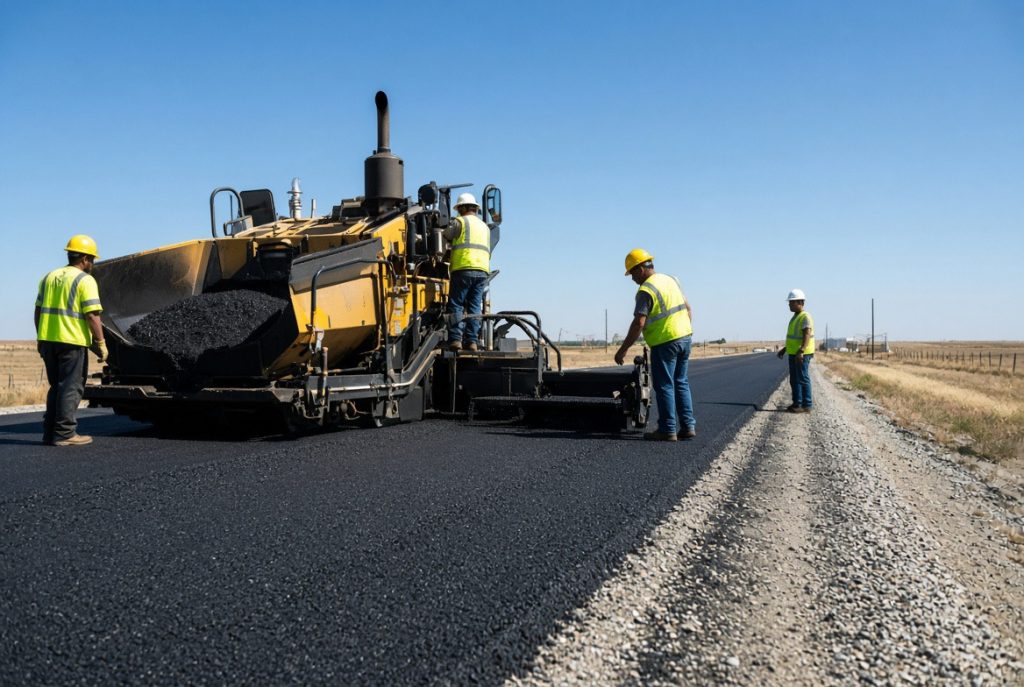
Texas is paving the way—literally—with recycled plastic. On State Highway 207 near Claude in the Panhandle, the Texas Department of Transportation (TxDOT) and researchers from the University of Texas at Arlington are testing plastic-infused asphalt as part of an ongoing pilot. The project, reported by local outlets in mid-November 2026, builds on earlier trials including campus parking lots at UTA in 2023 and a roughly 3,500-foot section of SH 205 in Rockwall that used several tons of recycled plastic (primarily bags and HDPE) in 2025.
The approach replaces about 8–10% of the petroleum-based bitumen binder with cleaned and shredded plastic waste that melts into the hot mix. Proponents, led by UTA civil engineering professor Md Sahadat Hossain, argue it creates more durable pavement that resists cracking, rutting, and heat damage while diverting plastic from landfills and potentially lowering costs since plastic can be cheaper than bitumen. Lab tests and early field results (including performance above 100°F) have looked promising, with claims of fewer potholes and longer service life. The Claude site was chosen in part because of expected heavy traffic from a nearby data center, allowing a high-stress real-world test alongside traditional asphalt for side-by-side comparison. Winter conditions and deicing chemicals will also be monitored.
On paper, it sounds like a win-win: less plastic waste and tougher roads for Texas’ extreme weather. In practice, it raises legitimate long-term questions that early lab and short-term field data have not fully answered.
The Breakdown Problem
Plastic does not simply disappear. It fragments over time under UV exposure, heat, abrasion from tires, weathering, and mechanical stress. Even when “bound” into asphalt, the material is not permanently inert. As roads wear—especially under heavy truck traffic, freeze-thaw cycles in the Panhandle, and the inevitable cracking that occurs over years—fine particles can be released.
This is not theoretical. Research on plastic-modified asphalt has measured microplastic release under simulated traffic abrasion. One 2022 study found that certain recycled plastics incorporated into asphalt can generate microplastics (in the 2–40 µm range), with cold temperatures and acidic conditions accelerating release. While some researchers, including those studying the Texas work, report that plastic-modified mixes release far fewer microplastics than tire wear particles (one 2024 estimate suggested roughly 1,000 times less), they also note that the plastic is largely “entombed” only while the pavement remains intact and uncracked. The entire point of the Claude and Rockwall pilots is to test long-term durability; until multi-year data under real conditions are available, claims of permanent containment remain provisional.
Hossain’s team and collaborating researchers have described release in their tests as minimal and well below certain allowable limits. That is encouraging but incomplete. Tire wear is already a massive microplastic source globally; adding another engineered source of plastic particles—even a smaller one—still contributes to the cumulative load.
Pathways into Water and Air
Your two core concerns are well founded:
- Leaching into aquifers and groundwater. Microplastics and associated chemicals can migrate with stormwater runoff into roadside soils, ditches, and eventually surface water or groundwater. Texas aquifers are already under pressure from agriculture, industry, and population growth. Plastics can adsorb other pollutants, and smaller fragments move more readily through soils. Landfill-style leaching analogies are imperfect (asphalt is far denser), but the principle holds: once particles leave the pavement matrix, they enter the broader environment. Encapsulation studies have shown high retention rates in lab conditions, yet real roads experience continuous abrasion, cracking, and water infiltration over decades.
- Airborne microplastic dust. Road surfaces generate dust through wear. Fine particles become resuspended by traffic and wind and can be inhaled. Microplastics have been documented in urban road dust, and inhalation is an established exposure pathway. In a rural or semi-rural setting like the Claude area, this may be less intense than in dense cities, but it is still a pathway for both nearby residents and anyone traveling the highway. Over time, cumulative exposure matters.
Early Texas-related research and statements from involved engineers emphasize that the risk appears low relative to existing sources like tires, and that better-performing pavement could reduce overall maintenance (and thus disturbance). Critics, however, have labeled aspects of the broader plastic-roads concept as potential greenwashing, noting that only certain plastic types work well and that the total volume of waste diverted is small compared with overall plastic generation. Long-term monitoring of actual particle release, chemical leaching, and end-of-life behavior (what happens when the road is milled or removed) is essential and still incomplete.
Proven Alternatives Already Exist
Organizations such as CARES of Texas offer soil stabilizers that have already demonstrated long-term performance in other states. According to Misty Collier and Chris Pettingill, one major airport in North Carolina applied this stabilizer to its truck road more than 15 years ago and has not had to repair a single pothole since. That kind of documented durability under heavy vehicle loads stands in contrast to an experimental plastic-asphalt mix whose multi-year environmental and structural performance is still being measured. Soil stabilization methods that strengthen the base without introducing plastics or other materials that fragment over time offer a lower-risk path to fewer potholes and longer pavement life—without creating new pathways for microplastics into aquifers or the air.
A Better Use for Landfill Waste: Plasma Gasification
Rather than embedding plastic and other landfill waste into roads where it will slowly fragment and disperse, a more productive approach is plasma gasification power plants. These systems use plasma torches at extreme temperatures (typically 3,000–10,000°C) to break down mixed municipal solid waste, plastics, and even hazardous materials into syngas (primarily hydrogen and carbon monoxide) and an inert, non-leachable vitrified slag.
The syngas can be burned to generate electricity or further processed into hydrocarbons, fuels, and chemicals. This delivers two practical benefits the plastic-road approach does not: cheaper or additional electricity for the grid and recaptured hydrocarbon products that can help lower costs at the pump or reduce reliance on imported petroleum products. Volume reduction is typically 85–95%, far more decisive than diluting a fraction of the plastic stream into pavement. Some life-cycle assessments find plasma gasification environmentally preferable to landfilling or conventional incineration on metrics such as global warming potential, and studies comparing it specifically to plastic incineration have shown higher electricity yields and stronger economic returns in modeled scenarios.
Challenges exist—high capital costs, parasitic power demand for the plasma torches (often 20–30% of gross output), and a still-limited track record of large commercial plants in the United States. Past projects have faced feedstock or economic hurdles. Yet the technology is feedstock-flexible, destroys organic contaminants thoroughly, and converts a disposal problem into usable energy and materials rather than creating a distributed, long-term microplastic source. Texas has seen related proposals, including plans for plasma-based waste-to-energy and fuel production near Houston. Scaling this approach would address landfill pressure while returning value in the form of power and hydrocarbons—exactly the kind of practical resource recovery Texas needs.
Context and Trade-offs
TxDOT and UTA frame plastic roads as addressing two problems at once: plastic waste and deteriorating roads in a state with punishing heat. That is a reasonable research question. Texas has a genuine need for more resilient pavement, and recycling suitable waste streams is preferable to landfilling when it can be done safely. The side-by-side design at Claude is a practical way to generate comparative data.
At the same time, caution is warranted. Embedding plastic in infrastructure creates a distributed, hard-to-recover source that will degrade under real-world conditions. Texas has seen other well-intentioned infrastructure experiments whose long-term environmental costs only became clear later. Protecting aquifers and air quality should take precedence over optimistic early results, particularly in areas with vulnerable water resources. Proven soil stabilizers already available through groups like CARES of Texas, combined with energy-recovery technologies such as plasma gasification for the waste stream itself, offer more established paths to durable roads and useful resource recovery.
The responsible path is rigorous, independent, multi-year monitoring of microplastic and chemical release from these test sections—under traffic, weather extremes, and aging—before any large-scale expansion. Until that data exist, treating plastic-infused asphalt as a proven environmental improvement is premature. Plastic does not stay put forever, and the fragments it leaves behind do not respect property lines, aquifer boundaries, or human lungs.
Texas can and should innovate on roads and waste. It should not do so by turning highways into slow-release plastic reservoirs without full accounting of the downstream costs. Plasma gasification plants offer a clearer path for landfill waste: recover energy and hydrocarbons, generate electricity, and avoid dispersing microplastics across the landscape. Meanwhile, field-proven soil stabilizers can deliver the pothole resistance Texas roads need without the experimental risks. The Claude experiment will generate useful performance data. It should also generate transparent environmental data. Those results, not the initial claims of durability and waste diversion, will determine whether this is a genuine advance or a problem deferred.