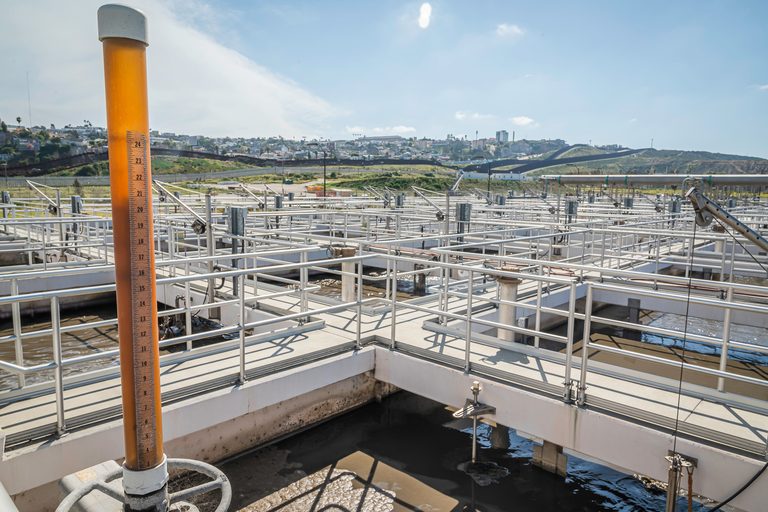
The International Boundary and Water Commission (IBWC) announced a $275 million funding shortfall for the expansion of the International Wastewater Treatment Plant that serves Tijuana, raising concerns for San Diego residents who rely on the plant to prevent sewage spills into the Tijuana River and the Pacific Ocean near Imperial Beach.
According to Voice of San Diego, the plant—built in the 1990s with binational funds—is slated to double its capacity under a plan the Trump administration says will “slash roughly 12 years of construction” and permanently end the sewage crisis. The administration pledged to complete the capacity‑doubling construction by Dec. 31 2027.
Dave Gibson, executive director of the San Diego Regional Water Quality Control Board, told the board that the IBWC is $275 million short of the nearly $1 billion needed for the upgrade. The shortfall pushes the total project cost to “almost $1 billion,” Gibson said.
MaryAnne Pintar, chief of staff for Rep. Scott Peters, noted that Congress previously secured $310 million in emergency funds for unexpected repairs and added, “We all jumped through circus hoops to get it and now they’re telling us they need this much more.” She said the higher cost reflects President Trump’s expectation that the plant treat double the sewage volume by the end of 2027.
Gibson said he told IBWC commissioner Scott McIntosh “five times” that the board expects the expanded plant to be in compliance with the Clean Water Act by 2030. The IBWC declined to comment, and spokesperson Frank Fisher said he had not received clearance to speak.
Without the expanded plant, up to 35 million gallons of sewage per day could flow untreated into the Tijuana River, threatening water quality for beachgoers in Imperial Beach and residents downstream. The Trump administration’s accelerated schedule aims to protect those communities.
What’s next: The IBWC is expected to seek additional federal appropriations to cover the $275 million gap, while local officials will monitor progress toward the Dec. 31 2027 deadline and the 2030 Clean Water Act compliance target.
Sources: voiceofsandiego.org