Alaska voters have spoken. The latest unofficial tallies from the Alaska Division of Elections, covering roughly 97% of the estimated 283,618 ballots, indicate clear outcomes in the state’s three highest‑profile contests.
Governor and Lieutenant Governor
Democrat Jonathan Kreiss‑Tomkins, running with Zac Johnson, has captured 141,623 votes, or 51.0% of the first‑choice total. By crossing the 50% threshold, Kreiss‑Tomkins avoids any ranked‑choice voting (RCV) transfers and is set to become Alaska’s first Democratic governor since Tony Knowles, as well as the youngest person ever to hold the office. The Republican ticket of Bernadette Wilson and Mike Shower trails with 77,943 votes (28.1%), while former governor Dave Bronson and his running mate Josh Church have 37,913 votes (13.7%). The remaining ticket of Treg Taylor and Candi English holds 19,977 votes (7.2%).
U.S. Senate
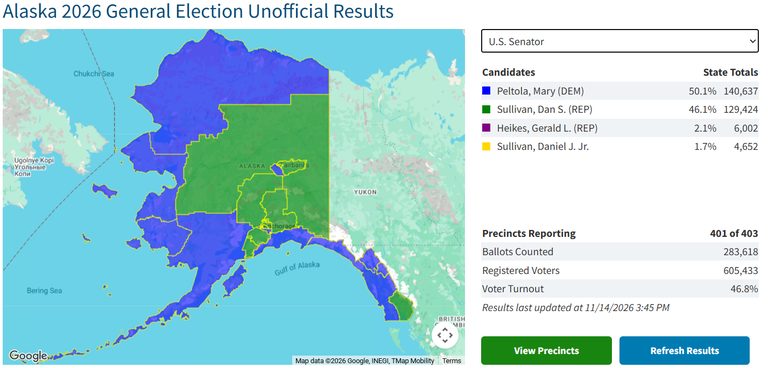
Incumbent Democrat Mary Peltola leads the Senate race with 140,637 votes, representing 50.1% of the first‑choice count. Republican challenger Dan Sullivan follows with 129,424 votes (46.1%). Two minor‑party candidates – Gerald L. Heikes (Republican) with 6,002 votes (2.1%) and Daniel J. Sullivan Jr. (independent) with 4,652 votes (1.7%) – together account for roughly 3.8% of the vote.
Peltola’s margin over Sullivan stands at about 11,213 votes. Because she fell just short of a first‑choice majority, the RCV process will be applied on November 18. Even if every voter for the two spoiler candidates had ranked Sullivan as their second choice, Peltola would retain a lead of roughly 600 votes, indicating a strong position heading into the final tabulation.
U.S. House
Republican Nick Begich leads the at‑large House race with 133,707 votes (47.8%). Nonpartisan candidate Bill Hill follows with 116,932 votes (41.8%). Democrat Eric Hafner, a New York felon, has 21,815 votes (7.8%) and Libertarian James C. “Jim” McDermott holds 7,384 votes (2.6%). Begich’s lead of approximately 16,775 votes is substantial, though he remains below the 50% threshold, meaning RCV transfers from Hafner, McDermott and write‑in voters will be counted on November 18. Preliminary RCV‑based tallies suggest Begich will retain the seat after transfers, with his margin narrowing only slightly.
Ballot Measures
Alaska voters also decided on two statewide measures. Measure 2, which would repeal open primaries and ranked‑choice voting, was rejected, with 144,098 “No” votes (53.6%) against 124,631 “Yes” votes (46.4%). The 2024 repeal effort failed by just 743 votes; the 2026 effort trails by roughly 19,467 votes, indicating continued voter support for the RCV system.
Measure 3, affirming that voters must be U.S. citizens, passed decisively, receiving 68.4% approval and 31.6% opposition.
Turnout and Voter Registration
Turnout for the 2026 midterm elections rose slightly to 46.9% compared with 44.4% in 2022. The state’s voter rolls grew by approximately 2,800 registered voters since the previous cycle, reflecting modest but steady engagement.
Ranked‑choice voting tabulation is scheduled for November 18 once the remaining eligible ballots are reviewed, with certification targeted for November 25. A small number of late‑arriving absentee ballots remain to be counted.
What This Means for Alaskans
The results signal a shift toward Democratic leadership in the governor’s mansion while maintaining Republican representation in the U.S. House. The Senate race remains competitive, with a narrow RCV process that will determine the final outcome. Voters have also reaffirmed the state’s commitment to ranked‑choice voting and citizenship requirements for the ballot, underscoring a preference for election reforms that promote broader participation and integrity.
Original reporting: Must Read Alaska (Anchorage) — read the source article.