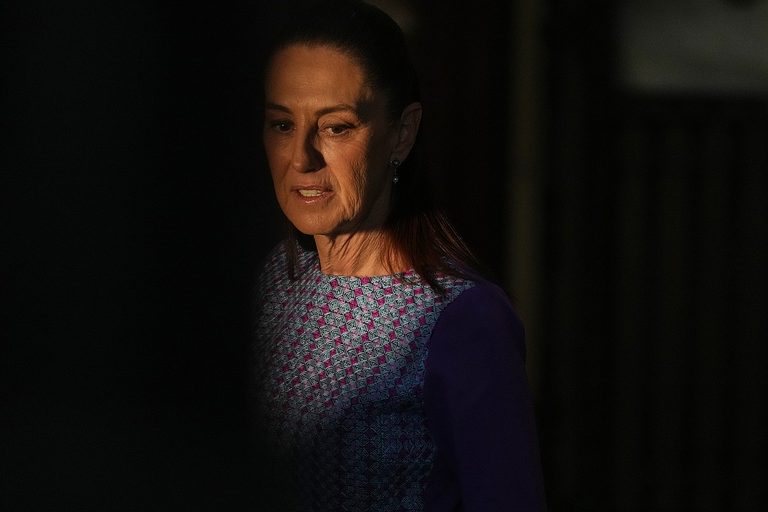
In a briefing in Mexico City, President Claudia Sheinbaum said that, since President Donald Trump resumed his term in January 2025, not a single migrant caravan has reached the United States border. Sheinbaum emphasized that a recent group of about 600 migrants traveling through Chiapas largely dispersed after authorities warned them that reaching the United States would be “very difficult.” She also noted ongoing talks with a second group of several hundred Honduran migrants, encouraging them to return home.
Trump’s tariff warning
President Trump responded on his Truth Social platform, claiming the United States faces an “invasion” after the recent midterm elections that gave Democrats control of Congress. He wrote, “Huge caravans are forming and beginning their illegal march through Mexico. Many of the people in these caravans are those that various countries don’t want. MEXICO MUST STOP THEM, NOW, and if they do not do so, the tariffs on Mexico will be IMMEDIATELY DOUBLED.” The threat targets the 10% duty on Mexican goods not covered by the United States‑Mexico‑Canada Agreement (USMCA), as well as a 25% duty on medium‑ and heavy‑duty trucks.
Trade negotiations continue
Despite the heated exchange, both nations remain engaged in negotiations aimed at reducing or eliminating duties Washington imposed on several Mexican products last year. The talks, which began in July, also address a 50% tariff on steel and aluminum and a 17% countervailing duty on Mexican tomatoes. Mexico is seeking significant cuts to these tariffs, hoping to ease the cost of imports for American consumers and support cross‑border trade.
White House staffing
Following the election, President Trump named Stephen Miller, a longtime architect of his hard‑line immigration policies, as White House chief of staff. Miller’s appointment underscores the administration’s continued focus on tightening immigration enforcement and leveraging trade policy to pressure neighboring countries.
Implications for Texas and the border region
For Texans living along the Rio Grande, the dispute highlights the delicate balance between border security and economic interdependence. While the Trump administration pushes for stricter immigration measures, the lack of recent caravan activity, as reported by Sheinbaum, suggests that current enforcement and deterrence efforts are already limiting large‑scale movements toward the U.S. border.
Local officials and business leaders in Texas are watching the negotiations closely. Reductions in tariffs could lower the price of Mexican goods ranging from fresh produce to automotive parts, benefiting both consumers and manufacturers that rely on cross‑border supply chains.
What’s next?
The next round of talks is expected to focus on concrete tariff reductions and the practical steps Mexico will take to curb irregular migration. Both sides have expressed a willingness to continue dialogue, but the rhetoric from Washington signals that any perceived laxity on migration could trigger swift economic retaliation.
As the debate unfolds, Texas residents can anticipate further statements from federal officials and potential policy adjustments that may affect everything from border patrol resources to the price of everyday goods.
Original reporting: Texarkana Gazette — read the source article.