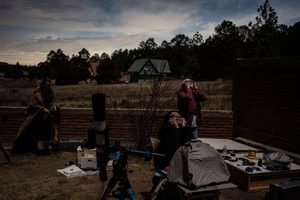
On August 12, a total solar eclipse will provide a stunning celestial display, marking the first such event in over two years. This astronomical phenomenon occurs when the moon passes between the sun and Earth, casting a shadow that fully blocks the sun’s light in certain areas.
Path of Totality
Sky-gazers in Greenland, Iceland, northern Spain, and northeastern Portugal will experience totality, where the sun is completely obscured, momentarily plunging the skies into darkness. A partial eclipse will be visible across parts of Europe, Africa, and North America.
This event is particularly significant for Spain, as it will be the first total solar eclipse visible from the mainland since 1905. The path of totality will stretch over 5,157 miles, starting near the Arctic coastline and passing over Greenland, Iceland, Portugal, and northern Spain.
Viewing Tips and Safety
It’s crucial to use proper eye protection when viewing the eclipse. Only during totality is it safe to look directly at the sun without specialized equipment. At all other times, certified eclipse glasses or solar viewers should be used. Sunglasses are not a substitute for these protective measures.
Scientific Opportunities
The eclipse presents a unique opportunity for scientific study. Researchers plan to launch high-altitude balloons to capture images and data, aiming to replicate a historic 1919 experiment that confirmed Einstein’s theory of general relativity. Citizen scientists are encouraged to participate by building instruments to measure atmospheric changes during the eclipse.
For those unable to view the eclipse in person, the European Space Agency will provide a livestream from Spain’s Astrophysical Observatory of Javalambre.
Original reporting: KTVZ (Central Oregon) — read the source article.