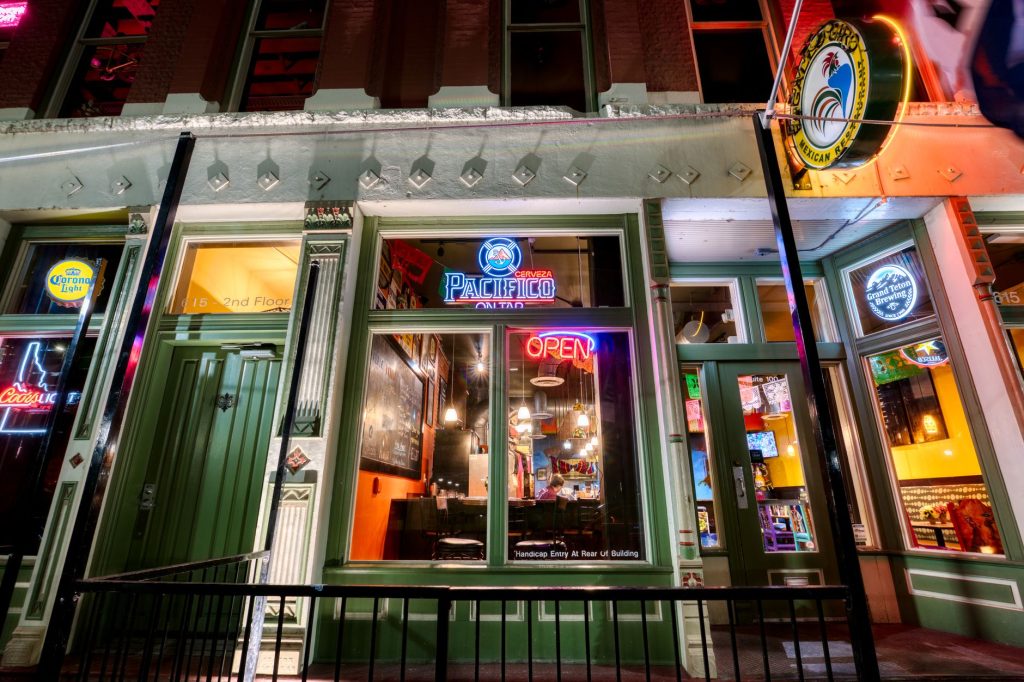
On a Friday evening around six, Montana Avenue starts to fill up. People are parking along the wide brick-paved street, cutting between old warehouse buildings that have been converted into bars, restaurants, and galleries. It doesn’t feel like a tourist district — it feels like where people in Billings actually go when they want a night out that doesn’t require driving to three different parts of town.
Montana Avenue runs roughly from 1st Street North down toward the rail yards, and the stretch worth your attention is concentrated between about 1st and 3rd. The buildings date mostly from the early 1900s — former wool warehouses, loading docks, light industrial spaces — and while some have been renovated fairly aggressively, enough original brick and timber survives to give the whole block a coherent character. It’s not a manufactured entertainment district. It developed piecemeal over about fifteen years, which is part of why it works.
Start at the east end if you’re doing this properly. The Railyard Brewing space anchors that side and pulls a crowd that skews younger, with rotating taps and a no-frills interior that suits the neighborhood. Work your way west and you’ll pass a handful of spots worth slowing down for. Harper & Madison is a cocktail bar that takes its drinks seriously — their amaro selection alone is worth a look, and a well-made old fashioned runs about $13. If you’re hungry, Walkers Grill (now under different management but still solid) handles the upscale end, while less formal options nearby cover pizza and pub food without much ceremony.
What makes this corridor genuinely useful rather than just atmospheric is the walkability. You can park once and move between three or four places in an evening without it feeling like an expedition. In a city laid out as sprawlingly as Billings, that’s not nothing. On warmer nights — roughly May through September — the sidewalks accommodate tables and the whole block takes on a different energy. In January it’s quieter, but the bars are still open and significantly less crowded if that’s your preference.
Gallery walks happen occasionally on the avenue, typically first Fridays, and they’re a reasonable reason to show up earlier in the evening. Several working studios and small galleries occupy second floors and converted spaces along the strip. Nothing here is going to rival a major city arts district, but the work tends to be genuinely local — Montana landscapes, Indigenous art, photography from the Yellowstone corridor — and the openings are low-pressure and free.
Pricing across the avenue is fairly consistent with what you’d expect in a mid-sized western city: a beer runs $6–$8, cocktails $11–$14, and dinner entrees at the sit-down spots land between $18 and $32. Street parking is free after 6 p.m. and usually available within a half-block.
This isn’t the only interesting part of downtown Billings, but it’s the most concentrated. If you’ve got one evening to spend and want to cover some ground without over-planning, Montana Avenue is the place to do it. Show up around six, eat somewhere mid-block, and see where the night goes from there.