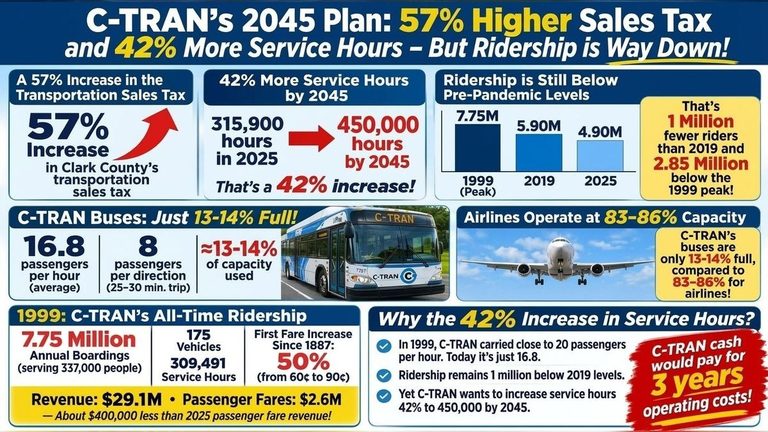
Clark County’s public‑transit authority, C‑TRAN, released its long‑range “2045 Plan” this week, outlining a dramatic expansion of service and a substantial increase in the county transportation sales tax. The plan proposes a 57 percent boost to the tax and an expansion of fixed‑route service from roughly 316,000 hours in 2025 to 450,000 hours by 2045.
Ridership trends and current performance
In 1999, C‑TRAN carried a record 7.75 million passengers on about 309,000 service hours, when Clark County’s population was roughly 337,000. By 2025 the county had grown to about 542,000 residents, yet annual boardings have fallen to about 4.9 million – a drop of 2.85 million from the 1999 peak and a million fewer than in 2019. The agency first reached the current 4.9 million figure in 1996, meaning today’s ridership is essentially the same as it was three decades ago despite a 200,000‑person population increase.
Average bus occupancy is low. A typical C‑TRAN bus carries about 13 passengers per hour, and the Bus Rapid Transit (BRT) line averages 28 passengers per hour. With a 60‑seat vehicle, that translates to roughly 13 percent capacity utilization. More than 80 percent of seats remain empty, a stark contrast to airlines that fill 83‑86 percent of theirs.
Rising operating costs
Since 2021, the cost to operate each service hour has risen from $156 to $218 – a 39 percent increase over four years, or about 10 percent annually. Annual operating and maintenance expenses now total $70.6 million, up $9 million (over 14 percent) in a single year, with administration costs climbing nearly 19 percent last year. The agency currently holds $231 million in unrestricted cash and investments, enough to cover roughly three years of operating costs if no sales‑tax revenue were received. Passenger fares cover only about 4.2 percent of annual operating expenses.
Plan rationale and proposed service changes
C‑TRAN describes the plan’s foundation as the “Vision Network,” an “unconstrained, community‑based ideal for future transit service” that imagines what the system could look like “if funding were unlimited.” The agency argues that expanding service hours and increasing the tax base will attract more riders and improve mobility for the growing county.
The proposal outlines a phased increase in service hours: an addition of 50,000 hours by 2029 to reach 365,900 hours, followed by a reduction of 97,900 hours in 2031 for one option, and further adjustments five years later. The “2045 System Growth” network would raise the number of peak‑service fixed‑route buses from 89 in 2030 to 97 in 2045, while aiming for the 450,000 annual‑hour target.
Critics point to low transit share and alternative solutions
Only about 1‑2 percent of Clark County workers currently commute by transit, well below the state average of roughly 3.4 percent. One regional transportation report labeled the county’s transit share “unusually low” at 1 percent of trips, down from 2.5 percent previously. The report noted that transit lost more ground than any other travel mode during recent years.
Critics also highlight emerging transportation technologies. Autonomous vehicle providers such as Waymo and Zoox are expected to offer point‑to‑point rides without a driver, potentially delivering faster, safer, and cheaper service than traditional bus operations. Self‑driving shuttle buses and real‑time data platforms could further reshape local mobility, yet these innovations are not addressed in the 2045 plan.
Board and public response
The C‑TRAN board has been urged to scrutinize the plan’s financial assumptions and to consider cost‑containment measures before approving any tax increase. The agency’s own data show that each bus currently carries only about 16.8 passengers per hour, calling into question the need for additional service hours at this time.
Residents have until midnight on Monday, November 16, to submit formal comments. Comments should be sent by email with the subject line “CTRAN 2045 Plan Input” to [email protected] or submitted through the agency’s online comment form at https://www.c‑tran.com/c‑tran2045.
Original reporting: Clark County Today (Vancouver WA) — read the source article.