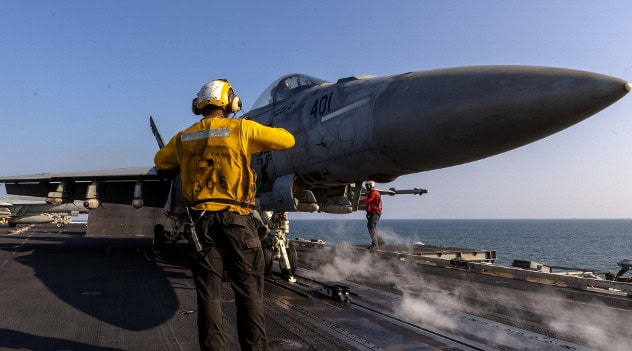
The fragile ceasefire between the United States and Iran was shattered as U.S. forces engaged in a significant exchange of fire with Iran across the Persian Gulf. This conflict directly threatens vital shipping lanes and neighboring countries in the region.
U.S. Central Command confirmed that American forces shot down four Iranian one-way attack drones overnight. These drones were reportedly heading toward the Strait of Hormuz, posing an immediate threat to regional maritime traffic. In response, the U.S. military launched retaliatory airstrikes targeting Iranian coastal surveillance radar sites located in Goruk and on Qeshm Island.
According to an official statement from CENTCOM, “CENTCOM forces remain vigilant and postured to continue responding to unwarranted Iranian aggression in self-defense.”
Regional Tensions Rise
Simultaneously, Iran launched a major missile barrage targeting neighboring Gulf states, with seven ballistic missiles aimed at Kuwait and Bahrain. Air defense systems successfully intercepted six of these missiles, while one failed to hit its target. Despite these interceptions, the situation in the region worsened.
Bahrain’s interior ministry announced on social media that emergency warning sirens were sounding across the island, urging citizens to remain calm and seek safety. Bahrain’s military reported that its air defense systems destroyed three additional missiles during ongoing attacks targeting civilians. The Bahraini military stated that its forces “are at the highest readiness.” Kuwait’s army also confirmed it was actively dealing with “hostile missile and drone attacks.” Both Gulf states host critical U.S. military bases.
Diplomatic Stalemate
The sudden spike in military activity comes as diplomatic efforts to secure a permanent peace deal between Washington and Tehran have stalled. Mohsen Rezaei, a military adviser to Iranian Supreme Leader Mojtaba Khamenei, stated that negotiations “are at a deadlock and Trump must break this deadlock. The ball is in Trump’s court.”
Rezaei demanded the U.S. unseal billions of dollars in frozen Iranian assets as a test to build trust. He warned that if the U.S. blockade continues, Iran could expand the conflict to other regions and launch attacks on U.S. bases. Rezaei dismissed the possibility of a direct meeting between Trump and the Supreme Leader.
President Trump, however, offered a different perspective. Before the overnight attacks, he stated that “the situation with Iran seems to be going quite well,” attributing delays in reaching an agreement to Iranian pride. Trump argued that previous U.S. administrations allowed the Iranian regime too much leeway, making current demands challenging for Iran.
Economic Impact
The ongoing closure of the Strait of Hormuz continues to pressure global markets, although Trump noted that oil prices remain at $97 a barrel, preventing a spike to $300. National Economic Council Director Kevin Hassett acknowledged that high gas prices and rising fertilizer costs are affecting consumers and farmers. He expressed optimism that these disruptions would be temporary once a deal is signed, though experts warn it could take until mid- to late-2027 for energy prices to stabilize.
Original reporting: Tampa Free Press — read the source article.