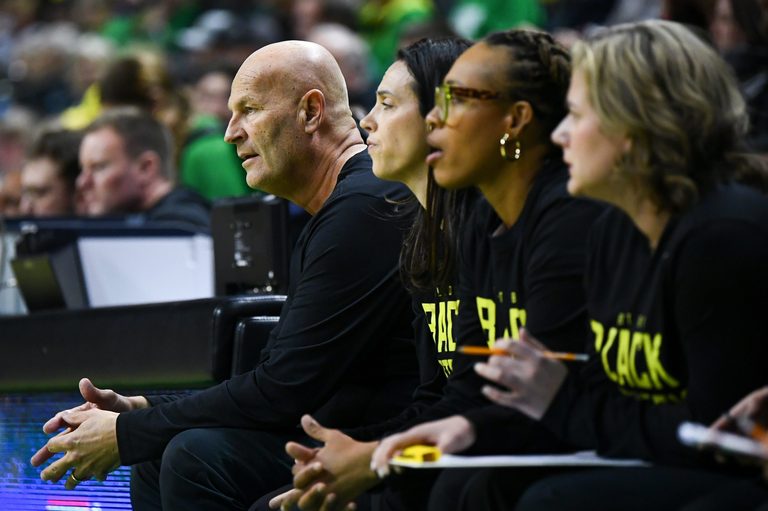
Oregon women’s basketball coach Kelly Graves is turning the team’s early‑season schedule into a cross‑country adventure. After a recent road swing that took the Ducks from the Grand Canyon to Vermont and now to Maine, Graves has coached games in 45 states and has only five left on his personal coaching bucket list: Delaware, Massachusetts, New Hampshire, Virginia and West Virginia.
Map pins and a travel‑ready roster
Graves, now in his 40th year of coaching and his 13th season with the Ducks, keeps a large map in his office marked with colored pins for every state where he has coached. “I’m a big atlas guy, a big map guy,” he said. “I put a blue pin for Gonzaga, red for Saint Mary’s and green for Oregon. With the Big Ten schedule, I realized I’d be at 40‑something states.”
The coach’s love of travel is more than a personal hobby. He believes the long flights and unfamiliar gyms help his players bond and develop resilience. “There’s so much bonding,” Graves explained. “You really get to know each other. Sometimes you don’t like the outcome — like Monday — but it makes us better.”
Recent road results
The Ducks lost a close game at the University of Arizona’s Grand Canyon campus, 81‑74, before catching a charter flight to Vermont. Junior guard Katie Fiso led the team with 18 points, seven rebounds and four assists as Oregon routed the Catamounts 81‑56. The next stop is the University of Maine, the easternmost point of the trip, a 3,447‑mile flight from Eugene.
Junior forward Ehis Etute from Luxembourg, who is seeing more of America than she expected, summed up the experience: “I don’t actually see a whole lot — really just the gym and the hotel.” Yet she appreciates the cultural exposure, noting her first taste of collard greens in Baton Rouge was “not what I’m used to” but a welcome addition to her college experience.
Why the travel matters for the Ducks
Graves argues that early‑season travel prepares the team for the rigors of Big Ten competition, where road games are frequent and often involve long distances. “Some teams play 11 or 12 non‑conference games at home and won’t have a true road game until January. That doesn’t work in the Big Ten, where so many teams have great home‑court advantages,” he said.
Freshmen and newcomers especially benefit from the exposure. “It definitely gives us a glimpse of what Big Ten travel is like, especially for the freshmen and newcomers,” Fiso added, after enjoying Vermont maple syrup and pancakes during the trip.
Coaching history and future goals
Before Oregon, Graves built Gonzaga’s women’s program into a mid‑major power from 2000 to 2014. He has amassed 651 career wins and remains enthusiastic about the next chapter. At 63, he says he is “really liking my team right now” and has no intention of stopping once the 50‑state goal is reached.
Graves also values the educational component of travel. Past trips have included a Capitol tour with U.S. Sen. Ron Wyden in Maryland, a campus tour at Southern University in Baton Rouge, and a visit to the Muhammad Ali Museum in Louisville. He hopes the upcoming games in Delaware, Massachusetts, New Hampshire, Virginia and West Virginia will offer similar learning opportunities.
Looking ahead
After Maine, the Ducks will head back west for their first Big Ten road series at Ohio State and Penn State at the end of December. The team’s schedule continues to blend competitive preparation with cultural enrichment, a formula Graves believes will serve the program well both on and off the court.
For the players, the road trips are more than just games; they are life‑changing experiences. “My family definitely thinks it’s cool we go everywhere,” Fiso said. “I always want to see new places.” Etute, who arrived in the United States with little knowledge of the country, looks forward to a future game at Rutgers, just an hour from New York City, a place she has long wanted to visit after watching the TV show Friends back home.
Original reporting: Homepage – Lookout Eugene-Springfield — read the source article.