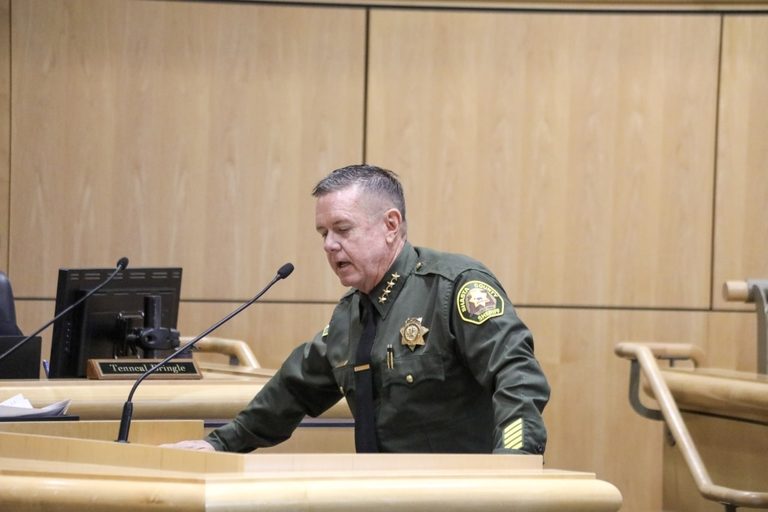
Shasta County Sheriff Michael Johnson used a Facebook post on November 12 to call on community members to attend the County Board of Supervisors meeting on Tuesday and publicly support the county’s automated license‑plate reader (ALPR) system, known commercially as Flock cameras.
Sheriff’s appeal highlights safety and constitutional compliance
In the post, Johnson warned that the board was hearing primarily from opponents of the technology and urged residents who favor “responsible use of this valuable investigative technology” to be heard. He described ALPR cameras as “one of the most important tools law‑enforcement agencies have,” asserting that the system operates in compliance with the Fourth Amendment and cannot be used for non‑investigative purposes in Shasta County.
The sheriff cited the county’s transparency portal, which lists 105 cases solved with the help of the cameras, and noted that data retained by the sheriff’s office is deleted after 30 days unless it is part of an active investigation. He also said the county shares ALPR data with more than 100 state agencies, but not with federal agencies, a practice confirmed by recent records‑request findings.
Opposition raises privacy and data‑security concerns
Opponents, organized under the group Flock Off Shasta County, argue that ALPRs threaten privacy, risk data breaches, and could erode public trust. Anderson City Council member Darin Hale voiced three main concerns: possible Fourth Amendment violations, uncertainty about permanent data deletion after the 30‑day period, and distrust of Flock’s business model, which he says relies on collecting and selling data.
Audit logs obtained through a public‑records request show that, for May‑June 2026, the county’s ALPR queries often lacked a documented reason code, a contrast to Anderson Police Department logs that did record reasons for each search. Johnson has not responded to a request for comment on this discrepancy.
Community voices and local officials weigh in
Among the more than 1,000 comments on the sheriff’s Facebook post, the majority echo Hale’s concerns, emphasizing resistance to expanded surveillance. However, some residents support the cameras, citing reduced crime and faster investigations, especially as law‑enforcement budgets face pressure.
Shasta County resident Steven Kohn acknowledged nationwide abuses of ALPR systems but argued that such incidents stem from improper use and should be addressed through stronger monitoring and safeguards rather than removal of the technology.
County supervisors seek balanced policy
Supervisor Matt Plummer has taken a middle‑ground stance, calling for robust county policies to prevent abuse before any decision to eliminate the system is made. In an email to constituents dated November 2, Plummer urged a public conversation on oversight and referenced recent court cases that suggest the constitutionality of ALPR cameras depends on deployment scope, data retention practices, and search protocols.
The Board of Supervisors will consider whether to terminate the contract with Flock or issue new directives to the sheriff’s office. A protest against the cameras is also scheduled before the meeting, indicating a likely full house.
As the debate unfolds, Shasta County residents are encouraged to attend the meeting, voice their perspectives, and stay informed about the safeguards being proposed for the ALPR program.
Original reporting: Shasta Scout (Redding) — read the source article.